
This guide takes a Joomla website from nothing to a marketplace of regional and local products: HikaShop for the shop, HikaMarket Multivendor for the stalls, and the Halle template for the look. It installs the three, sets up the template, builds the home page from modules, creates the menus, and sets up the marketplace itself: the vendors and their stalls, the vendor registration, the delivery of each stall and the free delivery. Every screenshot was taken on a real site while following these steps. You can see the result on the Halle demo.
- Before you start
- 1. Install HikaShop
- 2. Install HikaMarket Multivendor
- 3. Install Halle and make it the default template
- 4. Set up the template
- 5. Create the menus
- 6. Understand the module positions
- 7. Header and footer modules
- 8. Build the home page
- 9. Set up the marketplace with HikaMarket
- 10. HikaShop settings for the look of the shop
- 11. Before you sell
- 12. Your own CSS
- Questions
Before you start
- Joomla 6 and PHP 8.1 or later. Halle is a Joomla 6 template.
- HikaShop in its latest version, and HikaMarket Multivendor. Halle works with the Starter, Essential and Business editions of HikaShop and styles what they display; the stalls, the vendor lines on the products, the vendor pages, the map and the cart grouped by stall need HikaMarket Multivendor. A few modules mentioned below (the filters) only exist in HikaShop Business; this is said where they come.
- The packages, from your downloads on our website: com_hikashop_*.zip (HikaShop), com_hikamarket_multivendor.zip (HikaMarket) and tpl_halle.zip (the Joomla package of Halle; halle.zip is the WordPress theme).
- If you are changing the template of a site that is already online, make a backup first, and do the work on a copy of the site if you can.
In this guide the market is called Halle and its eight stalls are those of our demo (a farm, a goat dairy, a bakery, a cellar, a spice shop, a pottery, a beekeeper, a chocolate maker). The screenshots show the demo's products: yours will show your own stalls, categories and products.
1. Install HikaShop
- In the Joomla administrator, open System > Install > Extensions, and drop the HikaShop zip in the Upload Package File tab.
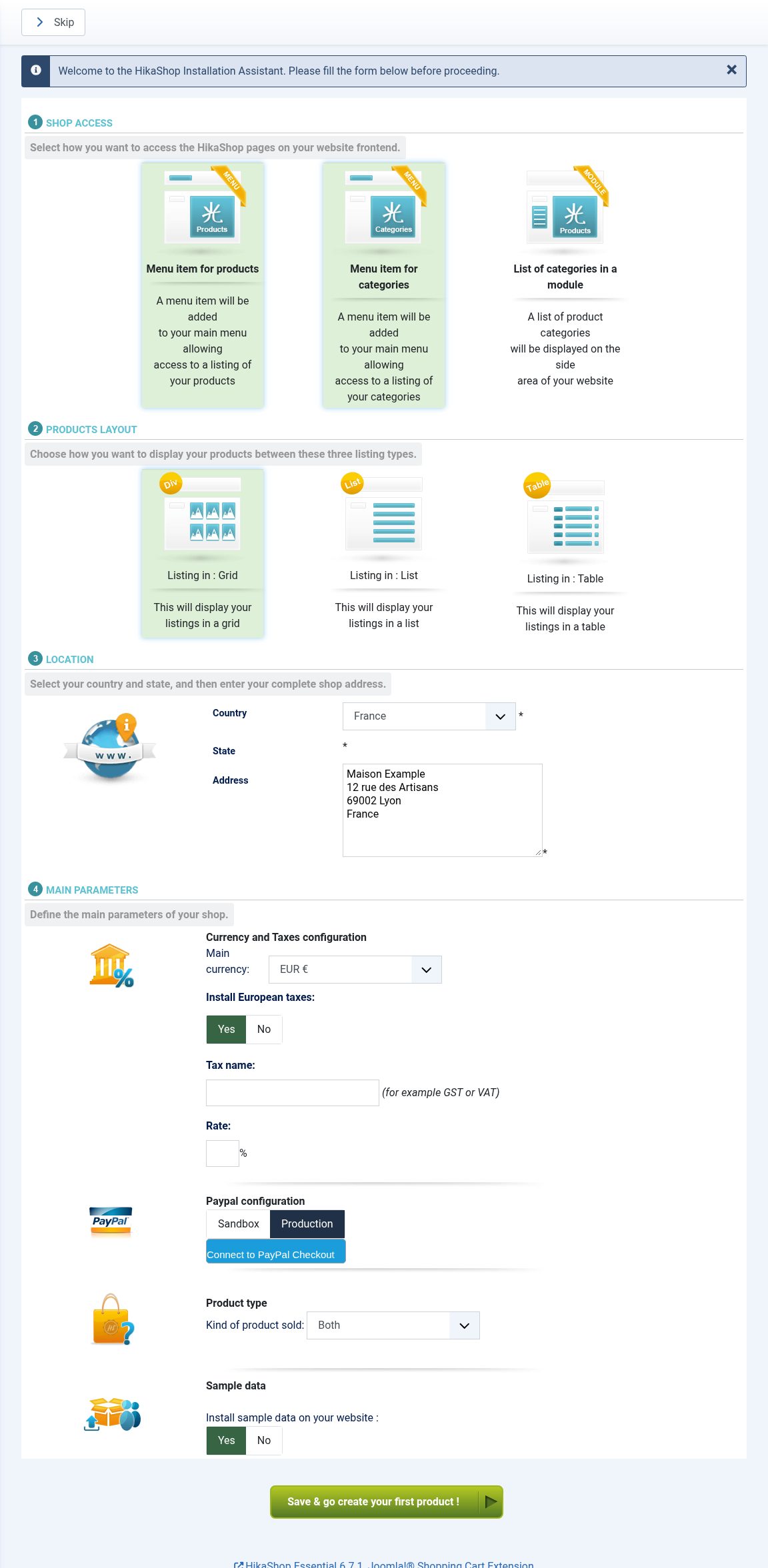
- When it is installed, HikaShop opens its installation assistant. Choose:
- Shop access: keep Menu item for products and Menu item for categories. Leave List of categories in a module unselected: with Halle you place your modules yourself.
- Products layout: Grid, the layout Halle styles for listings.
- Location: your country and the address of your market.
- Main parameters: your currency, and Install European taxes if you sell in the European Union.
- Sample data: Yes if you want a few categories and products to look at while you set up the template (they have no pictures; delete them later), No if you add your own goods straight away.
- Click Save & go create your first product.
More about the installation: Install / Update HikaShop.
2. Install HikaMarket Multivendor
- In System > Install > Extensions, drop com_hikamarket_multivendor.zip in the Upload Package File tab. The package installs the component with the plugins and modules it needs.
- Open Components > HikaMarket > Update / About once, so that HikaMarket finishes its installation and enables its plugins.
- In System > Manage > Extensions, check that the HikaMarket plugins and modules are enabled (filter on "market"). Halle uses the module HikaMarket (the stalls as cards), the module HikaMarket Vendor Map (the map of the stalls) and the HikaShop plugin HikaMarket, which adds the vendor to the products and the cart.
More about HikaMarket: the Multivendor tutorial and the configuration page.
3. Install Halle and make it the default template
- In System > Install > Extensions, drop tpl_halle.zip in the Upload Package File tab. The message "Installation of the template was successful" appears.
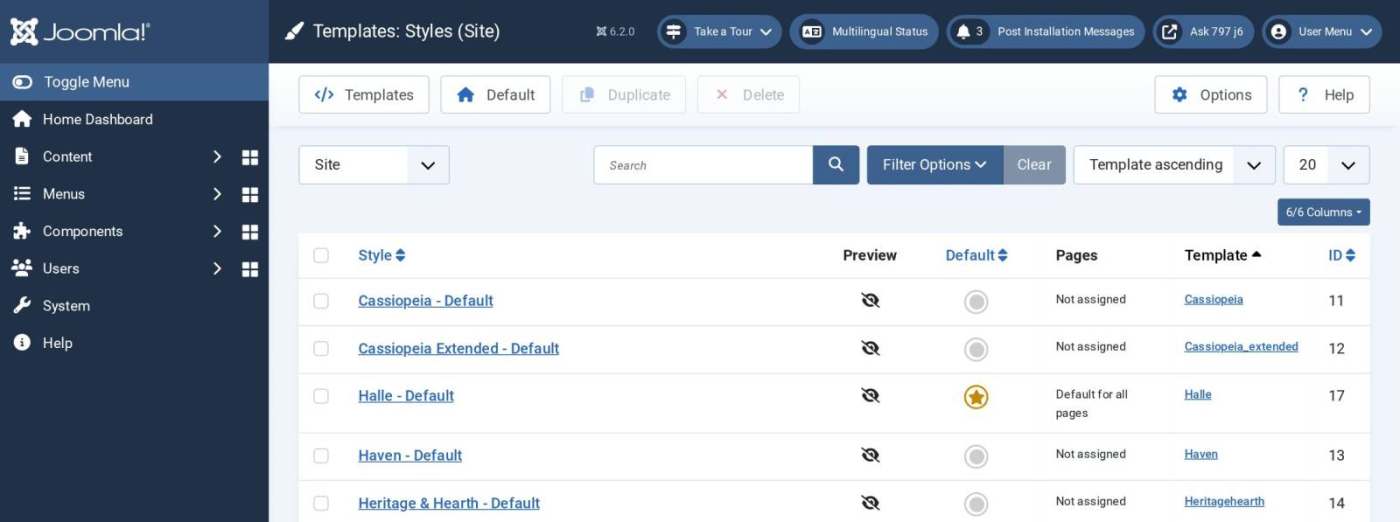
- Open System > Site Template Styles and click the star in the Default column of the line whose Template column says Halle. You can rename this style when you edit it.
If your site now looks empty: it is expected. Each template has its own module positions, and the modules of your site (the main menu, the login form...) are still in the positions of your previous template, which Halle does not have. Steps 5 to 8 put them in Halle's positions.
4. Set up the template
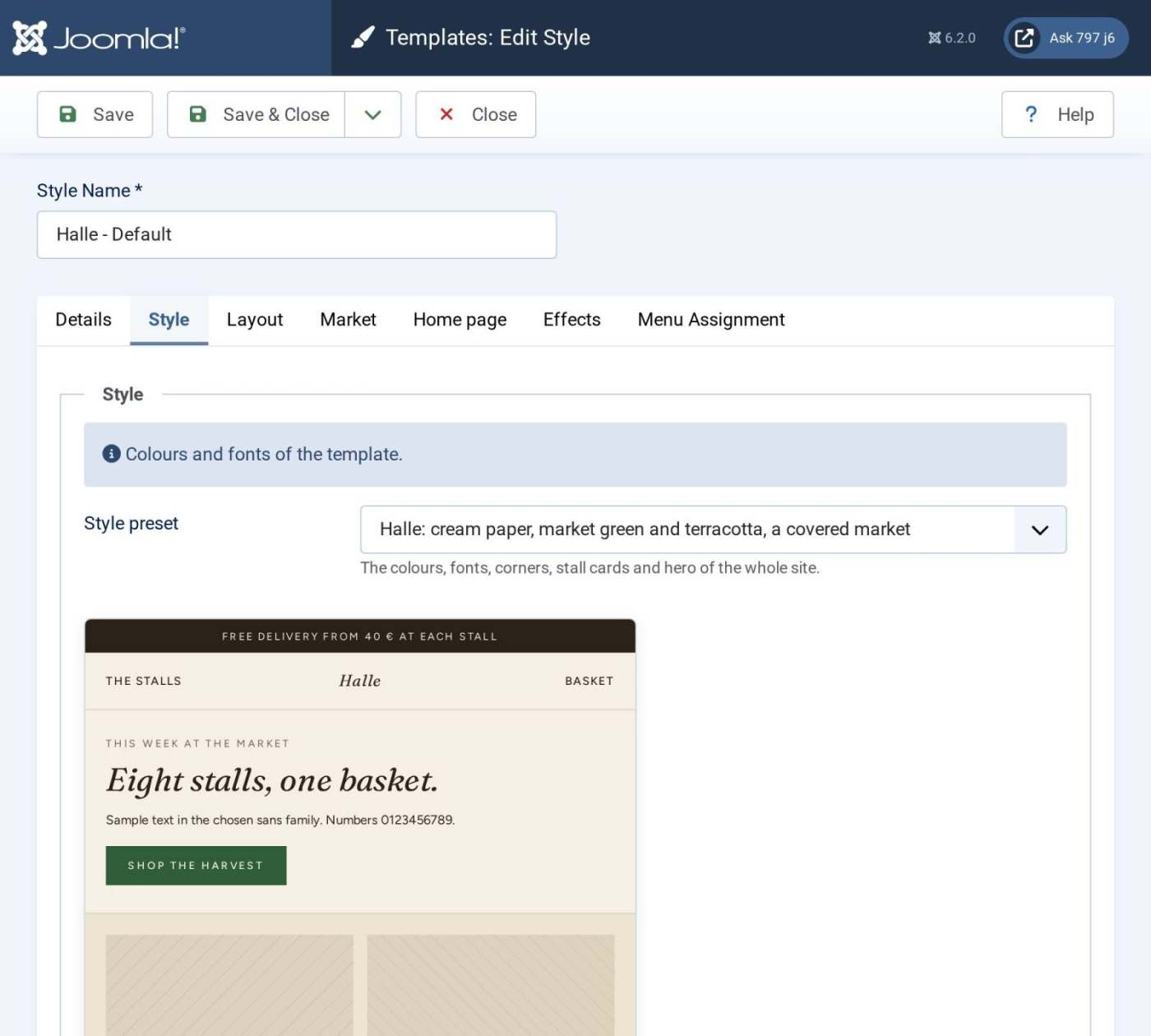
Click the Halle style in System > Site Template Styles. Its settings are in five tabs: Style, Layout, Market, Home page and Effects.
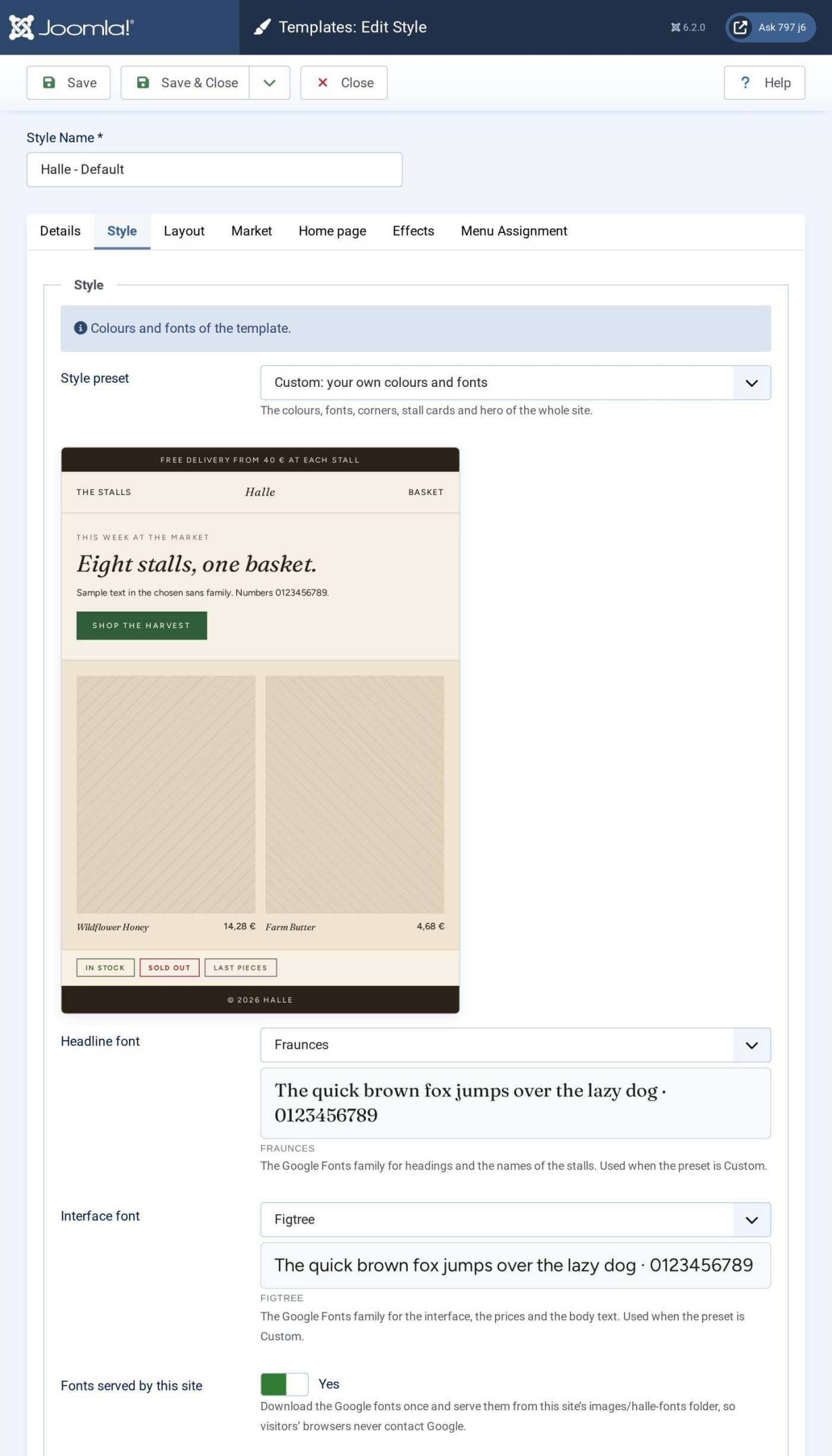
Style: colours and fonts
- Style preset: 13 ready-made looks (colours, fonts, corners, stall cards and hero together), two of them with a dark page: Halle (cream paper, market green and terracotta), Étal, Farmers market, Art market, Makers and craft, Christmas market, Spanish market, Japan market, Italian mercato, Flower market, Flea market, Night market and Seafood market. The preview under the list shows the one you pick. You can try them all on the Halle demo with its "Use your own style" button.
- Custom, the last choice of the list, shows the fonts and colours fields so that you set your own: a Headline font and an Interface font (Google Fonts) and eleven colours: Ink for the text, Paper for the page, Surface for the cards and the bands, Brand for the buttons and the bars, Brand, deep for the buttons pressed and the footer, Accent for offers, labels and the season's entry, Accent on dark for the accent on the footer, Sun for the stripes of a stall's awning and the badges, Line for the borders, Muted text and Alert for the last pieces and the sold out labels. A dark page works too: the HikaShop and Joomla boxes follow your colours.
- Fonts served by this site (yes by default): the fonts are downloaded once from Google Fonts and served from your own site (folder images/halle-fonts), so your visitors' browsers never contact Google.
Layout: logo, header, footer and the product gallery
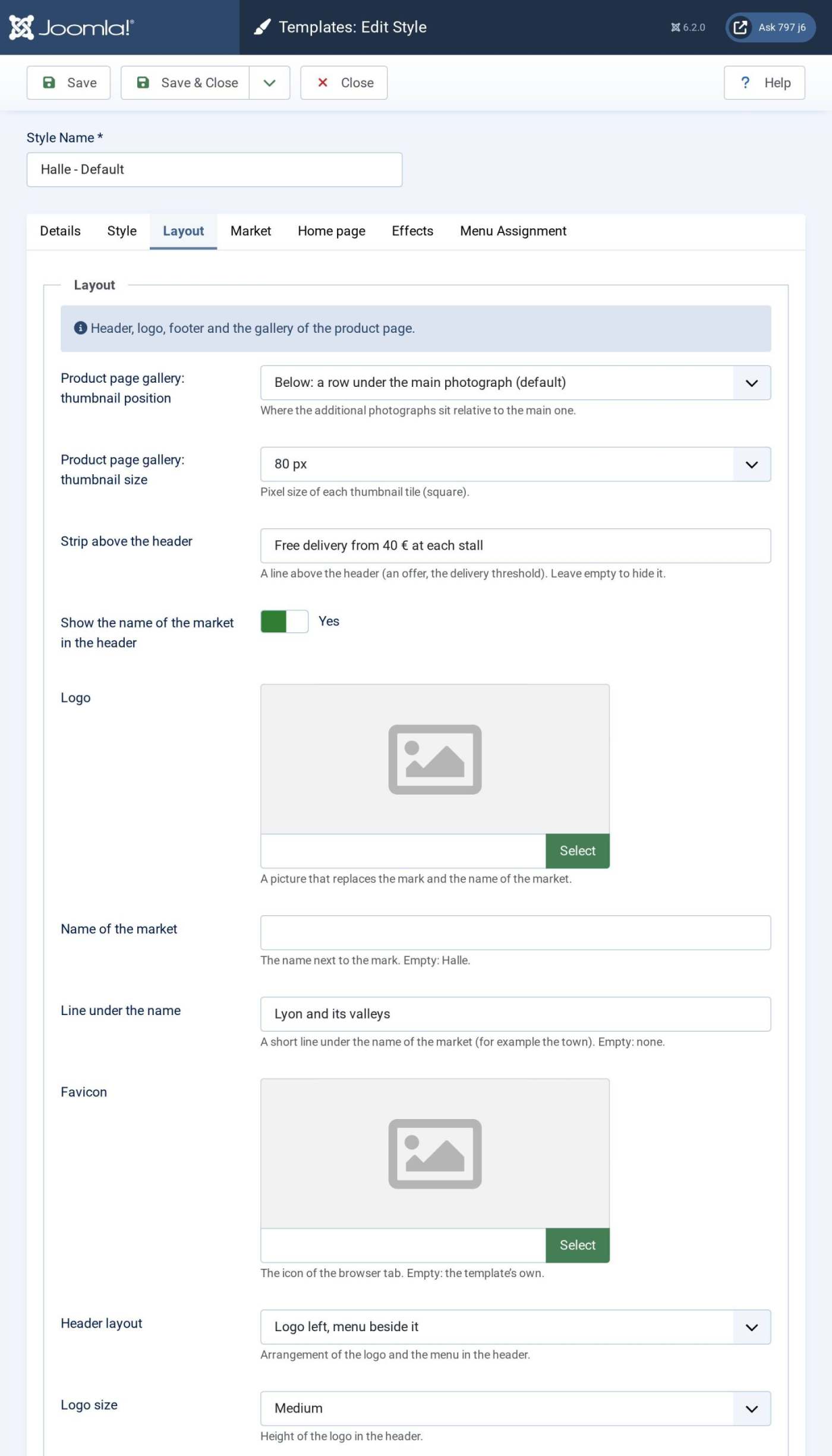
- Product page gallery: where the additional photographs sit (below, above, left or right of the main photograph) and the size of their thumbnails.
- Strip above the header: a line in the strip above the header, at the left (an offer, the delivery threshold). Leave it empty to hide it. Write it by hand: it is a text, not a calculation. When you change the free delivery threshold of step 9, change it here too.
- Show the name of the market in the header, Name of the market, Line under the name (for example the town), Logo and Logo size: without a logo, Halle draws its mark (a market stall) and the name; with a logo, your picture replaces both.
- Favicon, Header layout (logo left with the menu beside it, or logo centred with the menu below), Footer text (the last line of the page), Header stays at the top when scrolling and Back to the top button.
Market: stalls, vendor lines and delivery
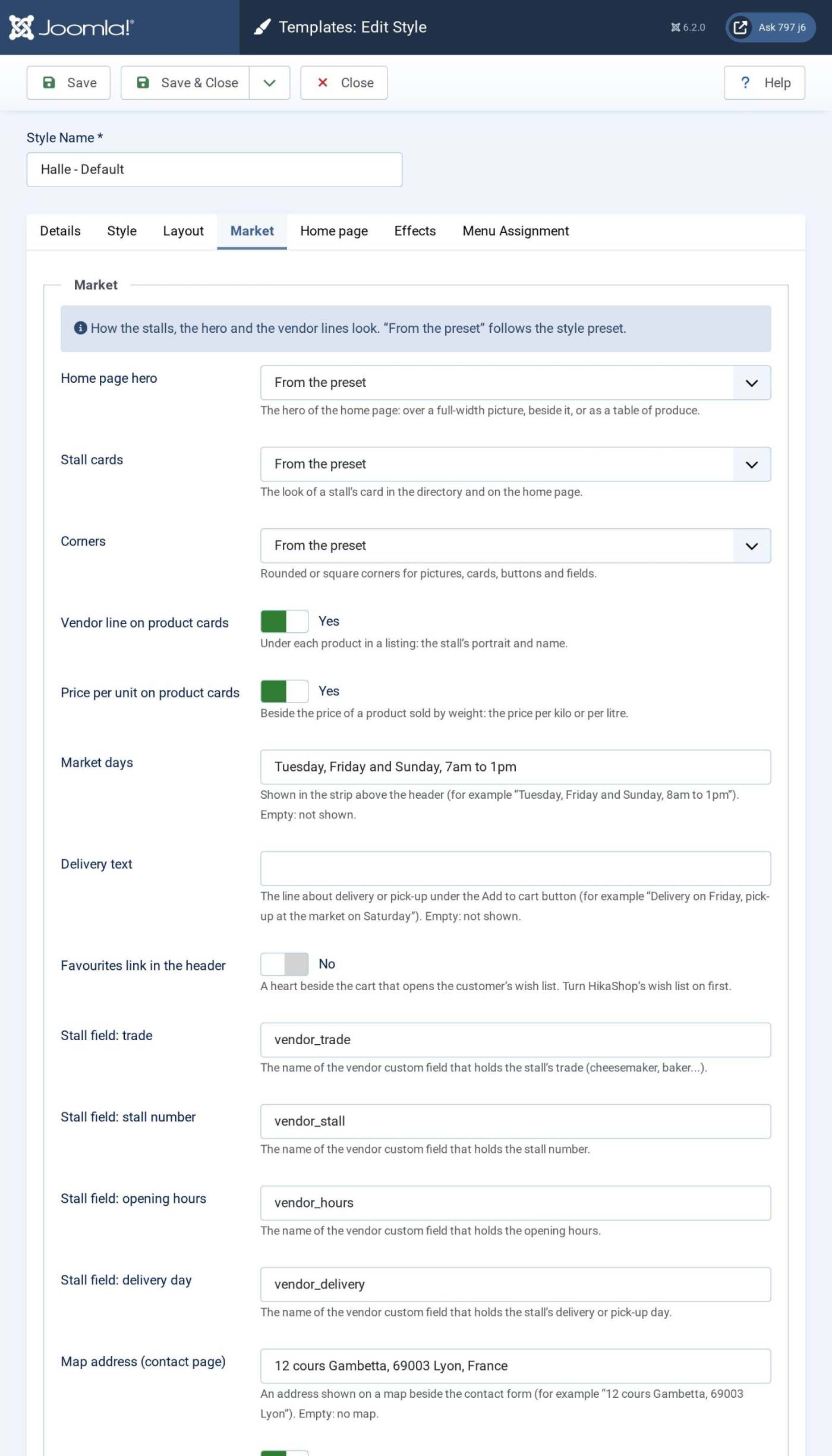
- Home page hero, Stall cards and Corners: From the preset follows the style preset; or choose. The hero is over a full-width picture, beside the picture, or as a table of produce; a stall's card is plain (portrait, name and trade), an awning (a striped awning in the stall's colour) or a photo (the stall's picture fills the card); the corners are rounded or square.
- Vendor line on product cards: under each product of a listing, the stall's portrait and name. Price per unit on product cards: beside the price of a product sold by weight, the price per kilo or per litre.
- Market days: shown in the strip above the header, after the strip text (for example "Tuesday, Friday and Sunday, 8am to 1pm"). Delivery text: the line about delivery under the Add to cart button of a product page when the stall has no delivery day of its own (for example "Delivery on Friday, pick-up at the market on Saturday"). A stall that has one shows it ("Delivery: Saturday"), with its opening hours.
- Favourites link in the header: a heart beside the cart that opens the wish list (turn HikaShop's wish list on first). Add-to-cart bar on phones: a bar fixed at the bottom of a product page on a phone, with the price and the button.
- Stall field: trade, stall number, opening hours, delivery day: the names of the HikaMarket vendor custom fields where a stall's trade, stall number, opening hours and delivery day are written (step 9). The defaults,
vendor_trade,vendor_stall,vendor_hoursandvendor_delivery, are those of the fields you create there. - Map address (contact page): an address shown on a map beside the contact form of Joomla's contact page. Empty: no map.
Home page: the hero
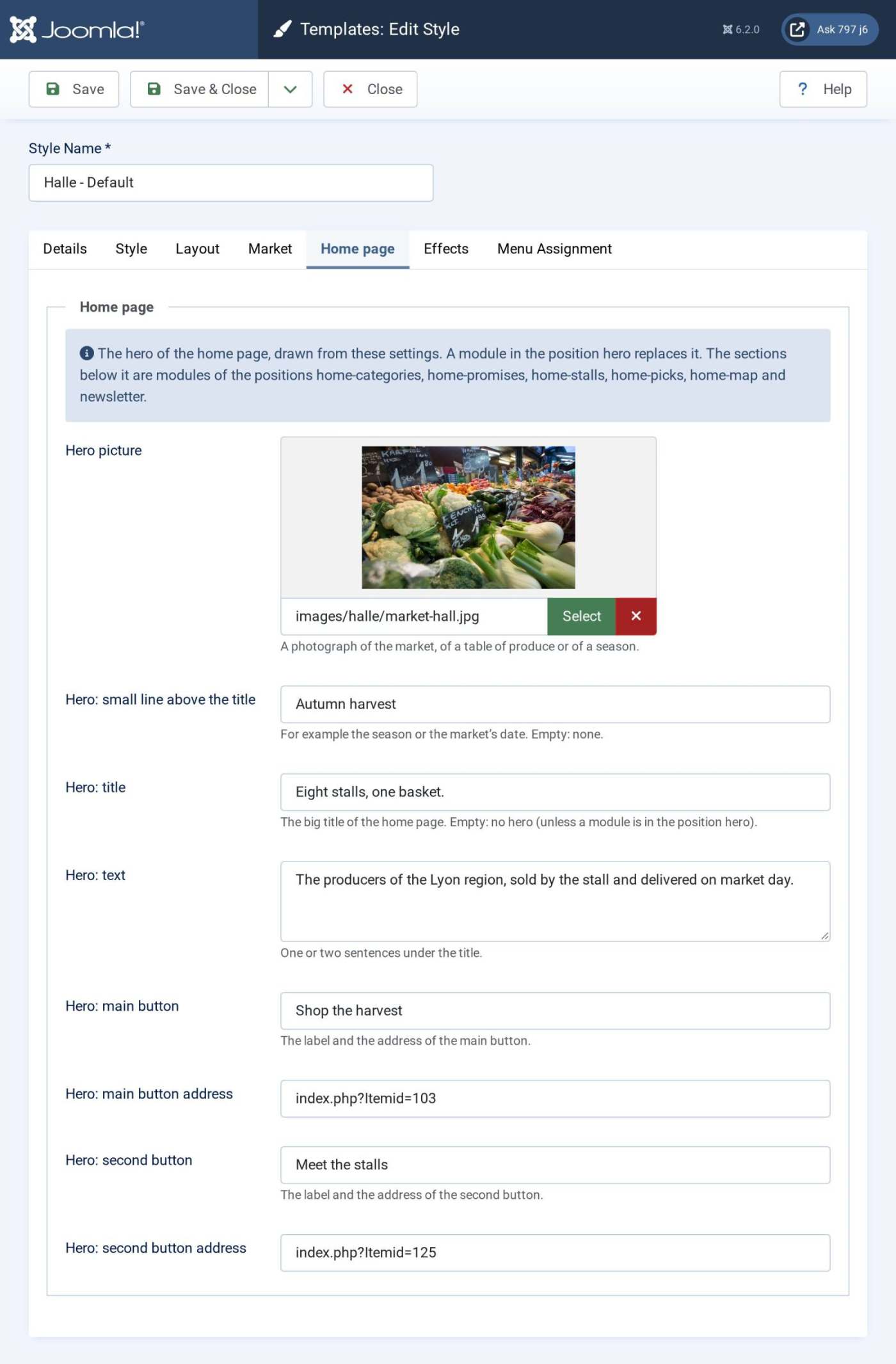
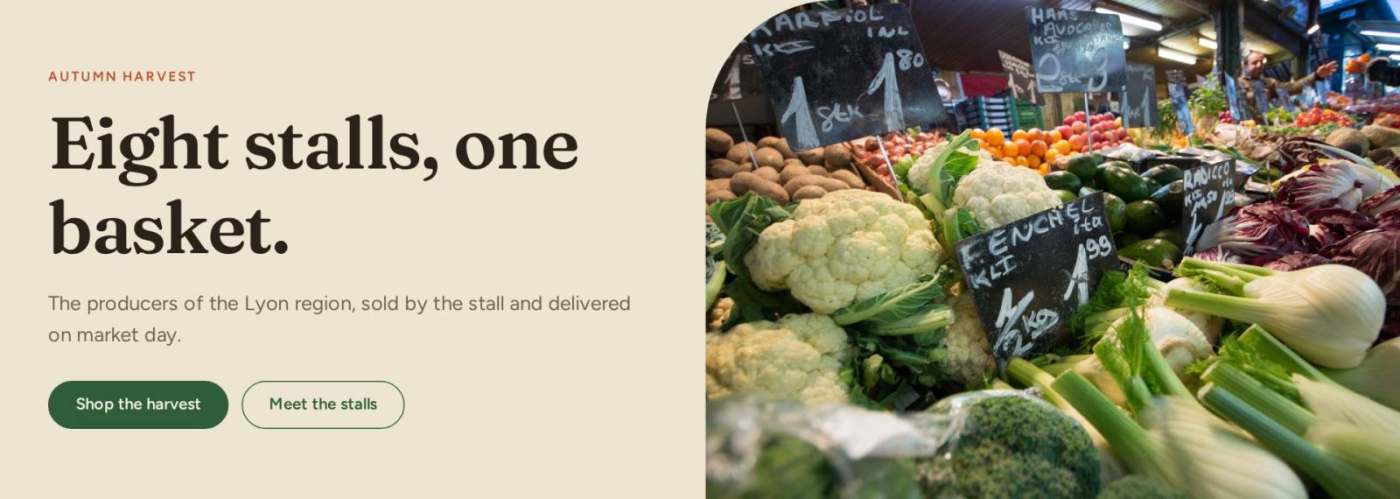
The hero of the home page is drawn from these settings: the Hero picture (a photograph of the market, of a table of produce or of the season), a small line above the title, the title, a text and two buttons with their addresses. Without a title and without a module in the position hero, there is no hero. The addresses of the buttons are those of Joomla pages: index.php?Itemid=105 (the number of a menu item, shown in Menus > All Menu Items) or a complete address.
Home page effects
Each section of the home page can appear with a short animation when the visitor scrolls to it: choose the effect (or No effect) and a delay for each section. Reveal duration is how long the animation lasts, Reveal threshold how much of a section must be visible before it starts.
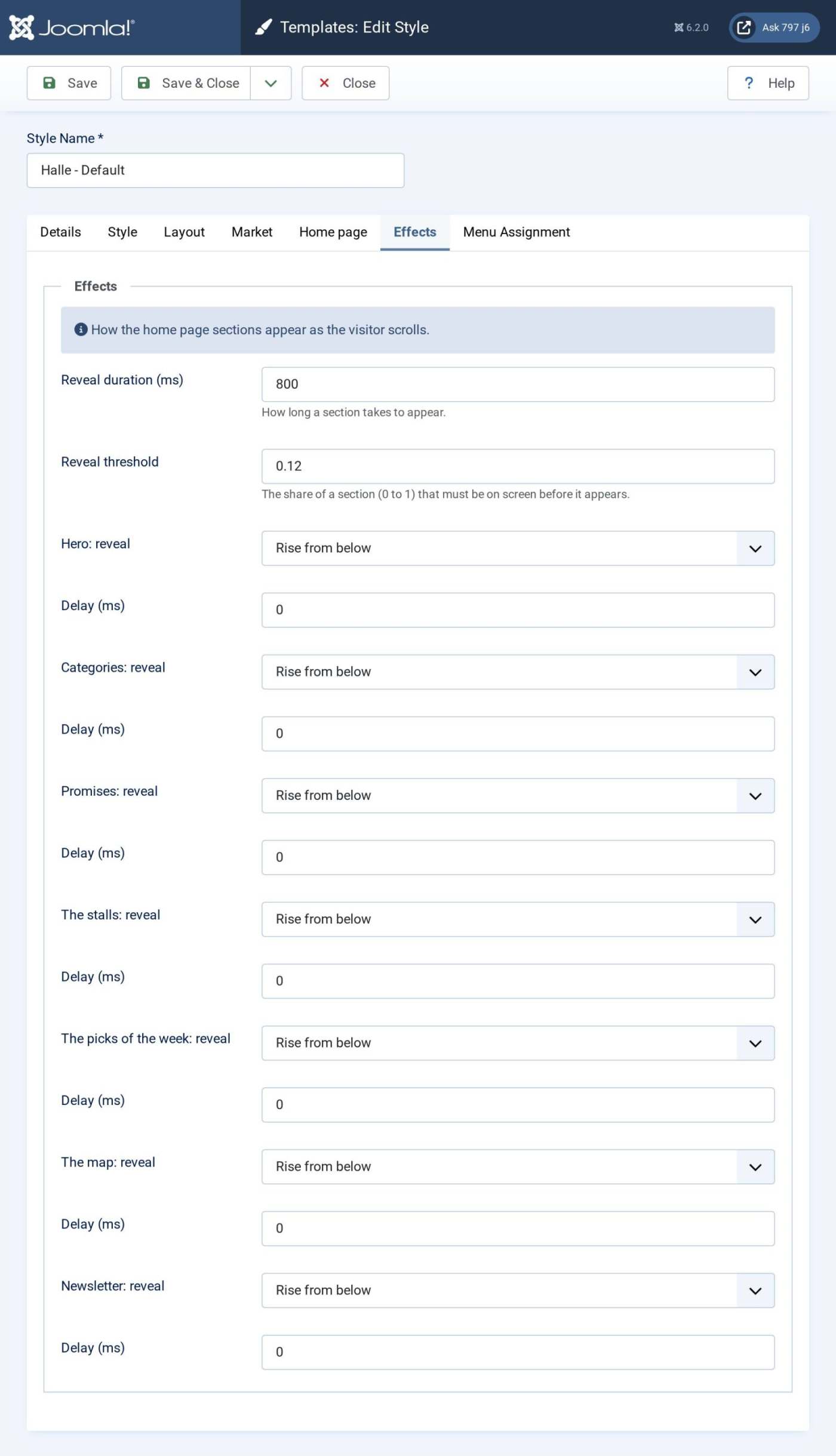
Click Save & Close.
5. Create the menus
The menu items decide the pages of your market and their addresses. Halle uses a main menu in the header and three small menus in the footer. Open Menus > Manage and create them with New:
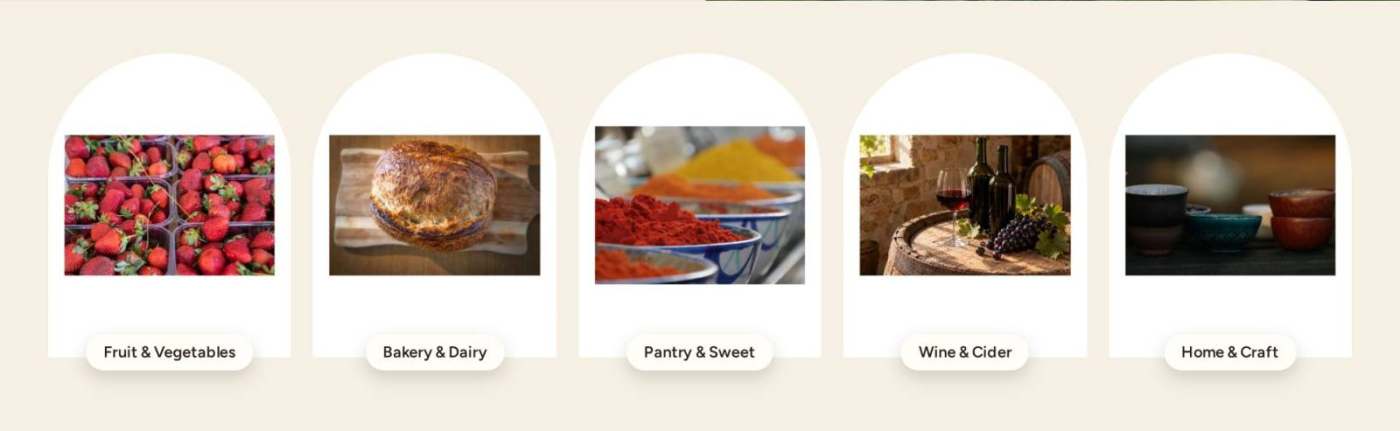
- Halle main menu, shown in the header: one Products listing item per department (Fruit & Vegetables, Bakery & Dairy, Pantry & Sweet, Wine & Cider, Home & Craft), then The stalls (a Vendor listing item) and a last item for the season ("In season").
- The market, Help and Legal, the three footer menus: About, The stalls, Become a vendor; Delivery and returns, FAQ, Contact, My account; Terms, Privacy, Legal notice.
Add an item with New, Menu Item Type: Select, then:
- HikaShop > Products listing: all your products, or the products of one category (set it in the Products Options tab, Select a category). Create one per department. The menu items of a HikaShop listing have many display options (columns, number of products, ordering, what each product box shows): see Content menu Edit.
- HikaShop > Checkout (the cart and the checkout) and HikaShop > User control panel (the customer's account: orders, addresses, downloads).
- HikaMarket > Vendor listing: the directory of the stalls. Vendor page: the front of one given stall. Vendor Control Panel: the vendor area, where a vendor manages their products and orders; it redirects to the login when the visitor is not logged in, so give it the access level Registered. Vendor edition: the vendor's own stall form; it shows the registration form to a visitor who is not a vendor yet, so it is the type of your "Become a vendor" item.
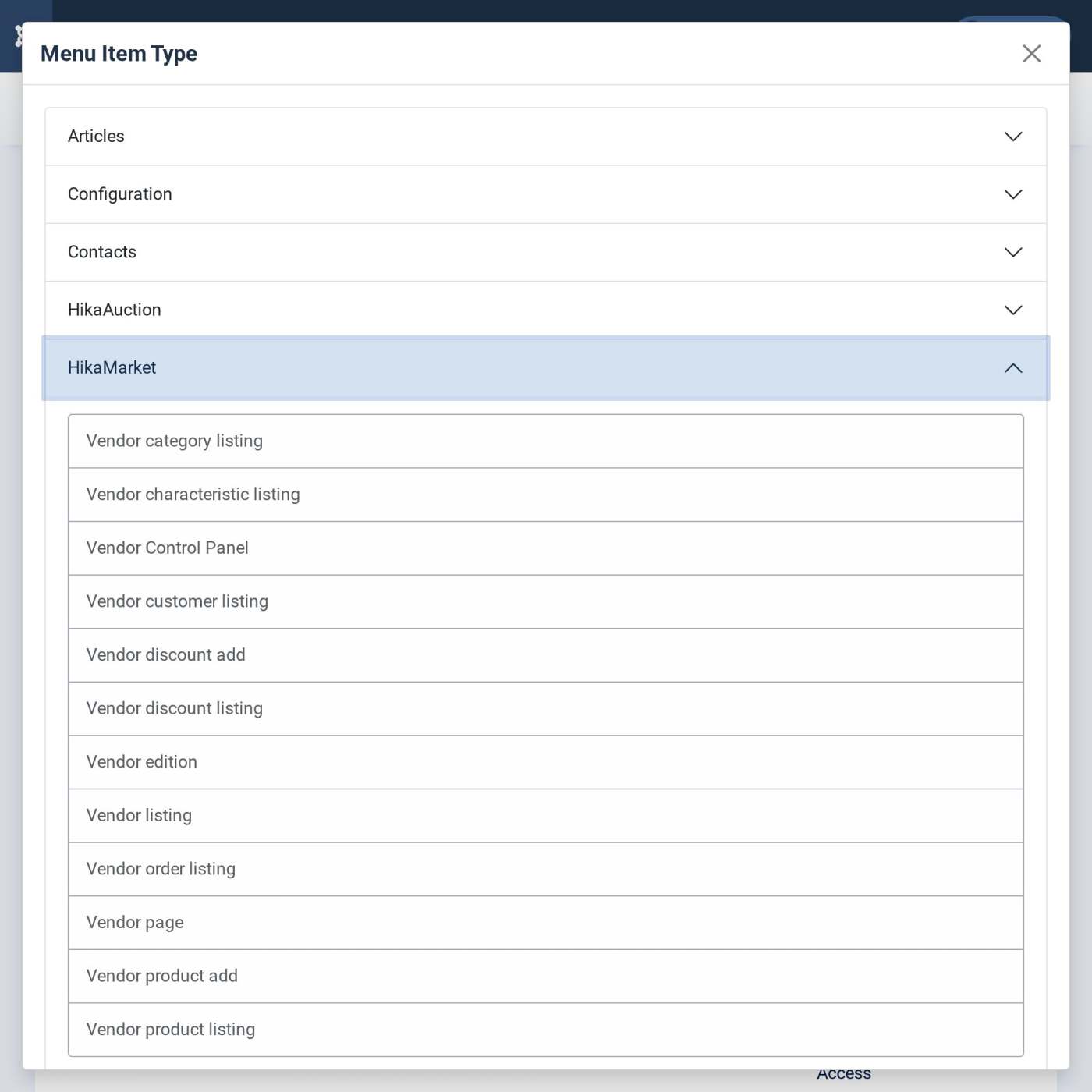
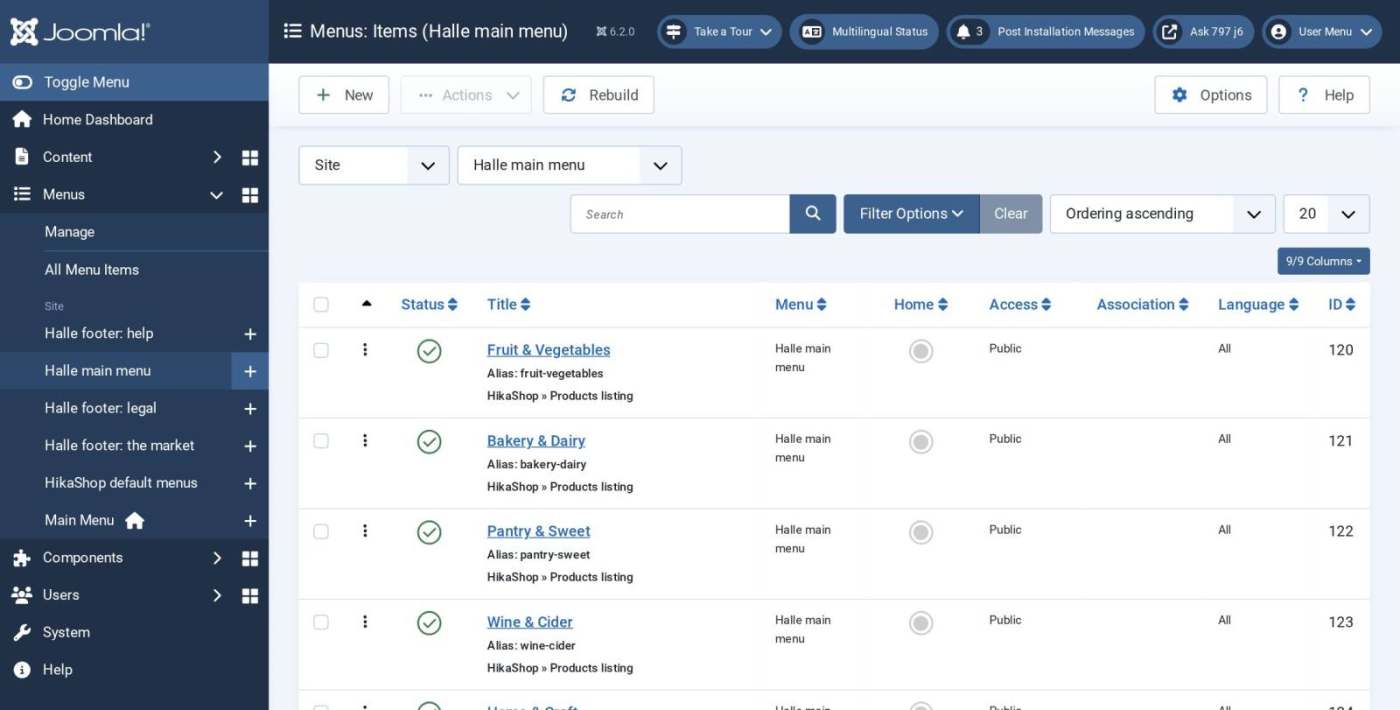
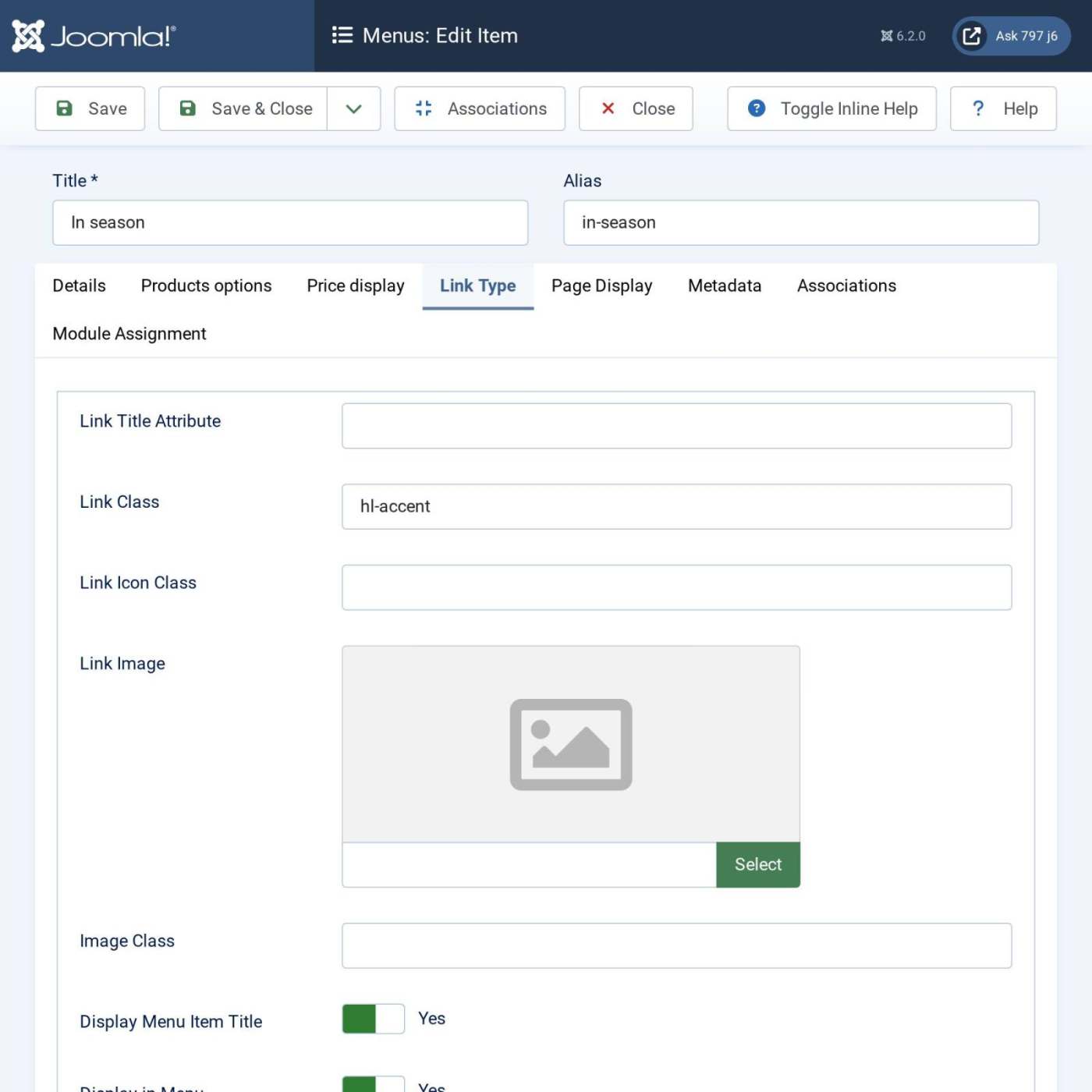
Put the season's item in the accent colour: open it, and in its Link Type tab write hl-accent in Link Class. Any item can take this class.
The Home item stays the one with the house in the Home column, and its type must stay Featured Articles: Halle shows the home page sections (step 8) on that page only. Open it, and in its Page Display tab set Show Page Heading to Hide: the hero is the title of the home page.
Then put the menus in the right modules: the Main Menu module of the position menu shows Halle main menu (step 7), and one Menu module per footer menu goes in the positions footer-a, footer-b and footer-c.
6. Understand the module positions
A module appears where its Position says. Halle has these positions:
| Position | Where | What to put there |
|---|---|---|
| announcement | The strip above the header, at the left | A Custom module, if the Strip above the header setting is not enough: it then replaces the strip text and the market days |
| topbar | The strip above the header, at the right | The language switcher, the HikaShop currency switcher |
| logo | In the header, next to the logo | Rarely used |
| search | In the header, the wide search box | A Smart Search module (step 7) |
| menu | Under the header | The Menu module of Halle main menu |
| header-icons | In the header, right of the account link | The HikaShop Cart module (the bag icon and the cart drawer) |
| hero | Home page, full width under the header | A module that replaces the hero of the Home page tab |
| home-categories | Home page: the departments | A HikaShop module showing categories |
| home-promises | Home page: the promises of the market | A Custom module |
| home-stalls | Home page: the stalls | The HikaMarket module |
| home-picks | Home page: the picks of the week | A HikaShop module showing products |
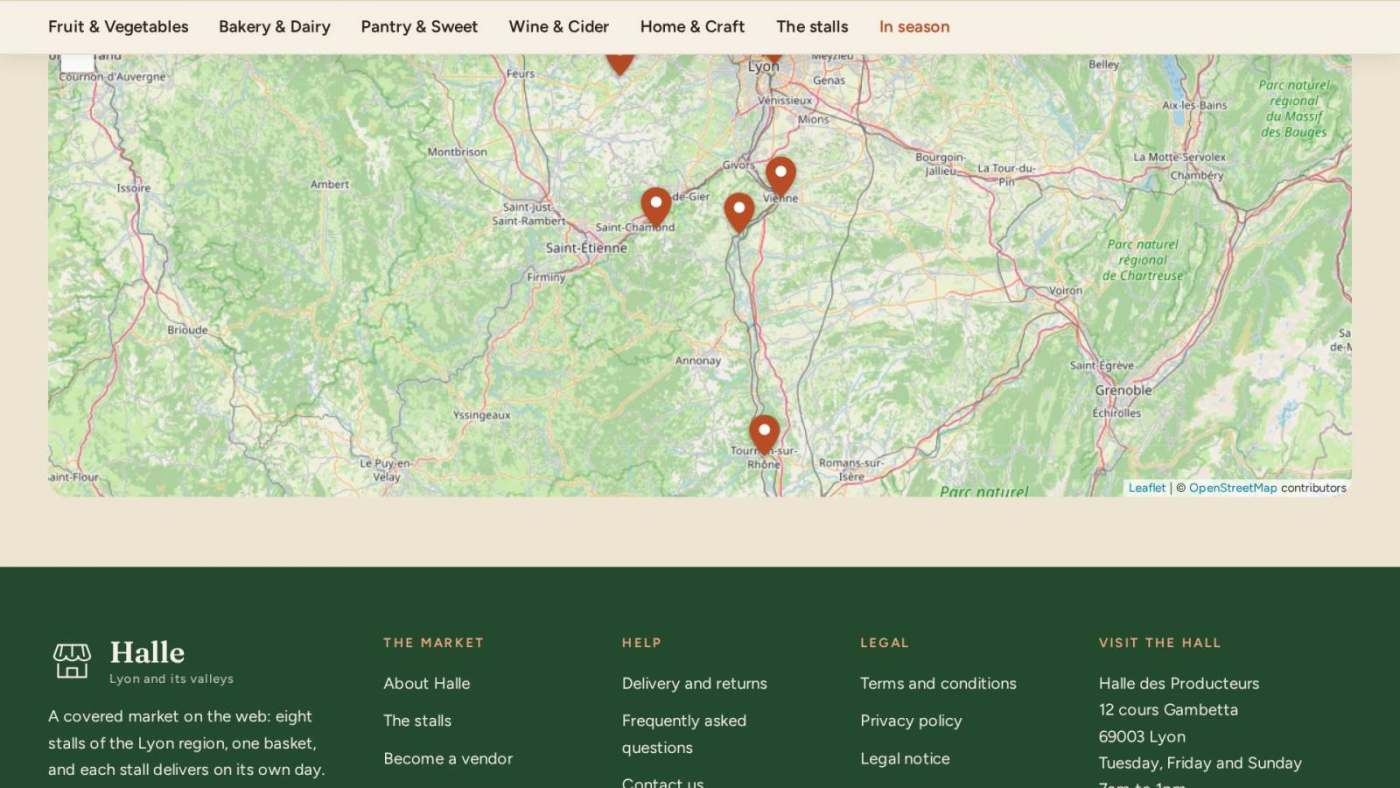
| home-map | Home page: the map of the stalls | The HikaMarket Vendor Map module |
| newsletter | Home page and every page, before the footer | A newsletter form |
| breadcrumbs | Under the header on every page but the home page | The Breadcrumbs module |
| sidebar-left | Left of the product listings | The HikaShop Filter module (HikaShop Business) |
| sidebar-right | Right of the other pages | Anything: it is empty in the demo |
| main-top, main-bottom | Above and under the content of a page | Anything |
| bottom-a, bottom-b | Two rows under the content | Anything |
| footer-brand | Footer, the first column | A Custom module: the name and a few words of the market |
| footer-a, footer-b, footer-c | Footer, the three columns of links | A Menu module each |
| footer-d | Footer, the last column | A Custom module: the address and the opening hours |
| footer-bottom | Footer, the last line | Anything (the Footer text setting is already there) |
| halle-stall | None (a module of no page) | The products of a stall, for its front page (step 9) |
Each module has a Menu Assignment tab: the home sections are assigned to all pages, and only the home page shows them.
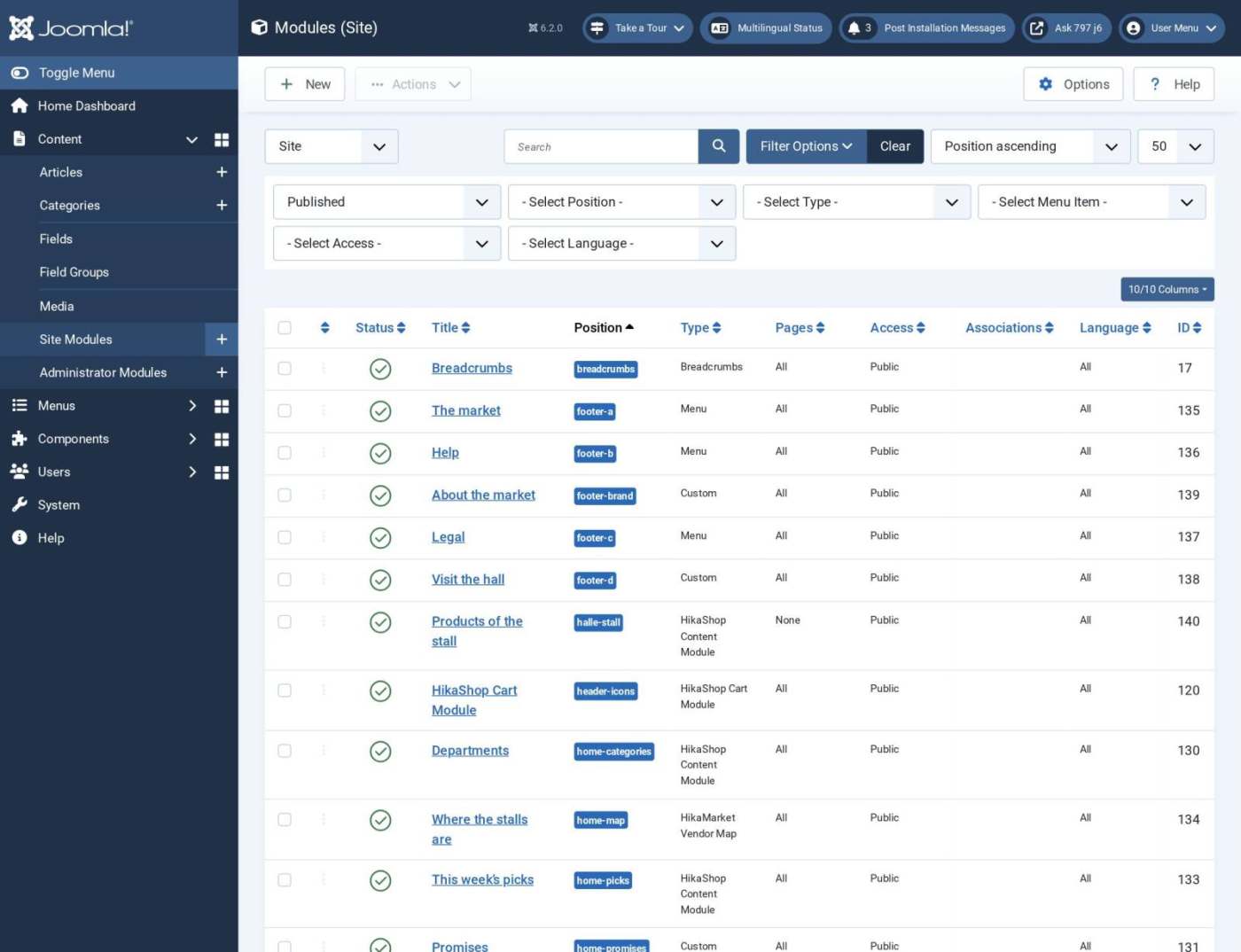
7. Header and footer modules
- Main menu: edit the module Main Menu (type Menu), position
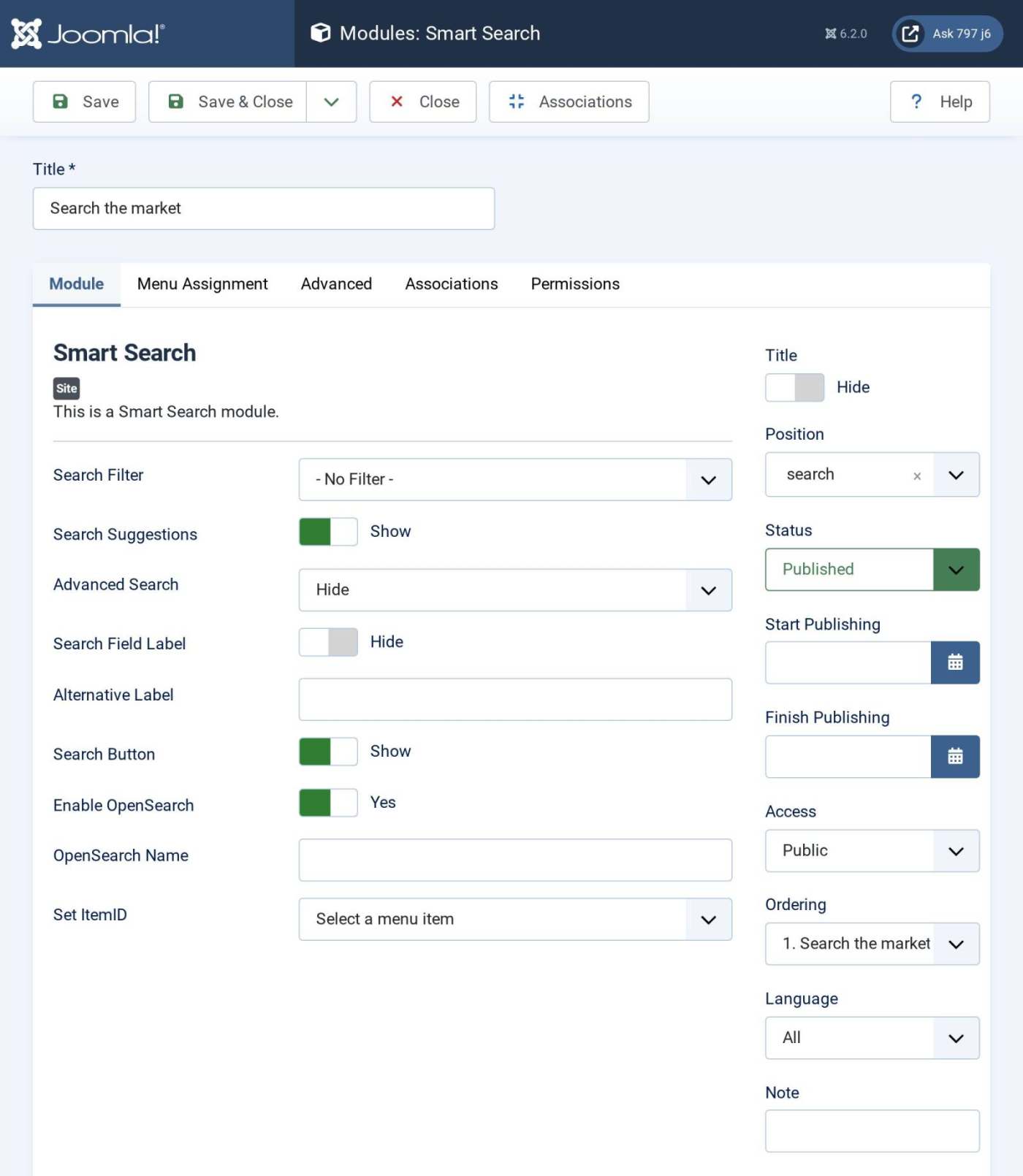
menu, and choose Halle main menu as its menu. Its start level is 1 and it shows all the items. - Search: create a Smart Search module (Content > Site Modules > New, type Smart Search) in the position
search, with the title hidden, Search Button and Auto Suggest on and the label hidden. Halle draws it as a wide box with a round button. Joomla's Smart Search must have indexed your products: Components > Smart Search > Index. The HikaMarket Smart Search plugin (Smart Search - HikaMarket Vendors) indexes the stalls too, so a visitor finds a stall by its name. - Cart: the HikaShop Cart Module in the position
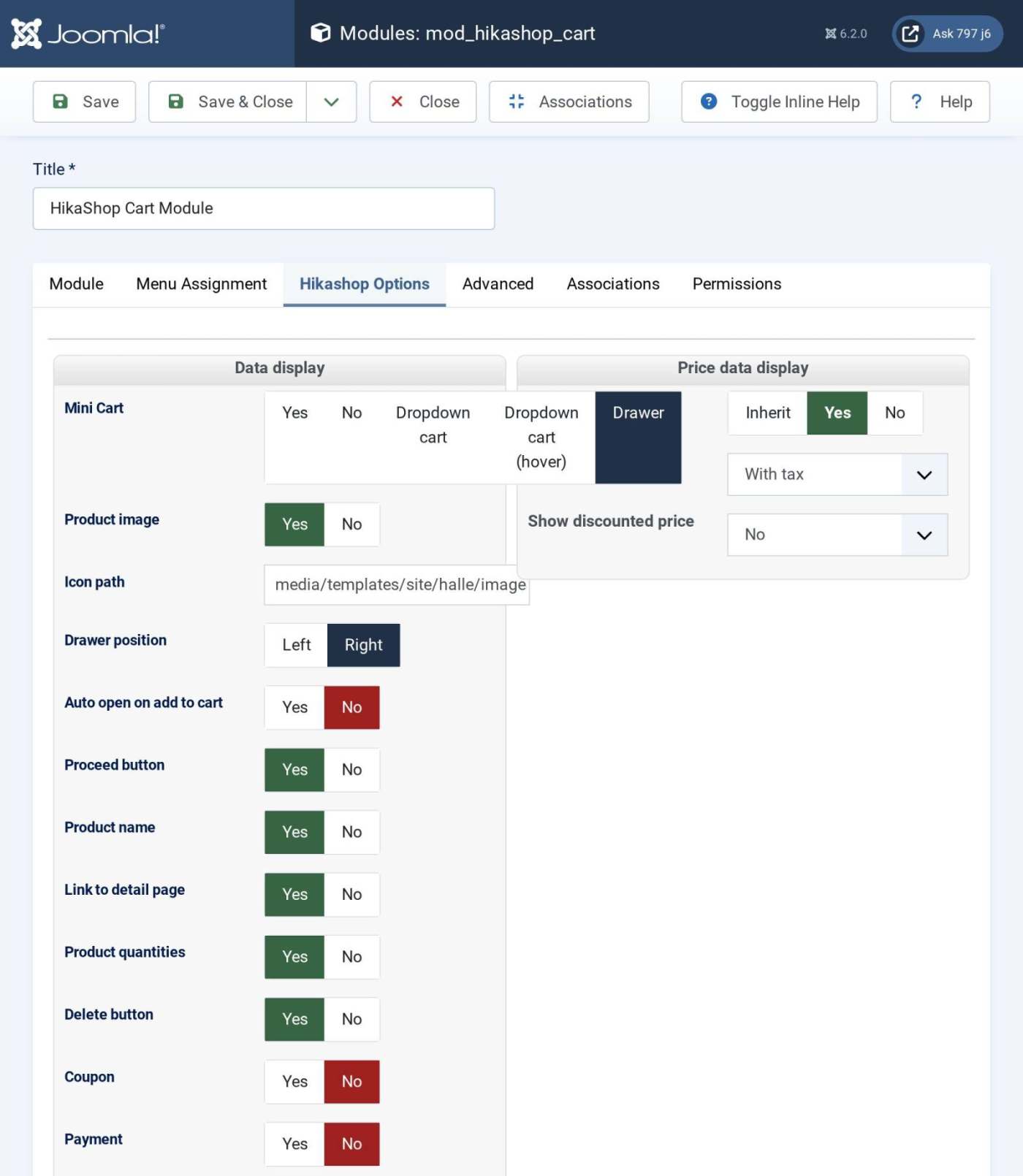
header-icons. In its Hikashop Options tab choose Mini Cart = Drawer with the Drawer position on the right, and as its Icon path the bag of the template:media/templates/site/halle/images/bag.svg. The drawer groups the products by stall, with the delivery day of each. See Cart module. - Language switcher: a Language Switcher module in the position
topbar, if your site has several languages. - Footer: one Menu module per footer menu in
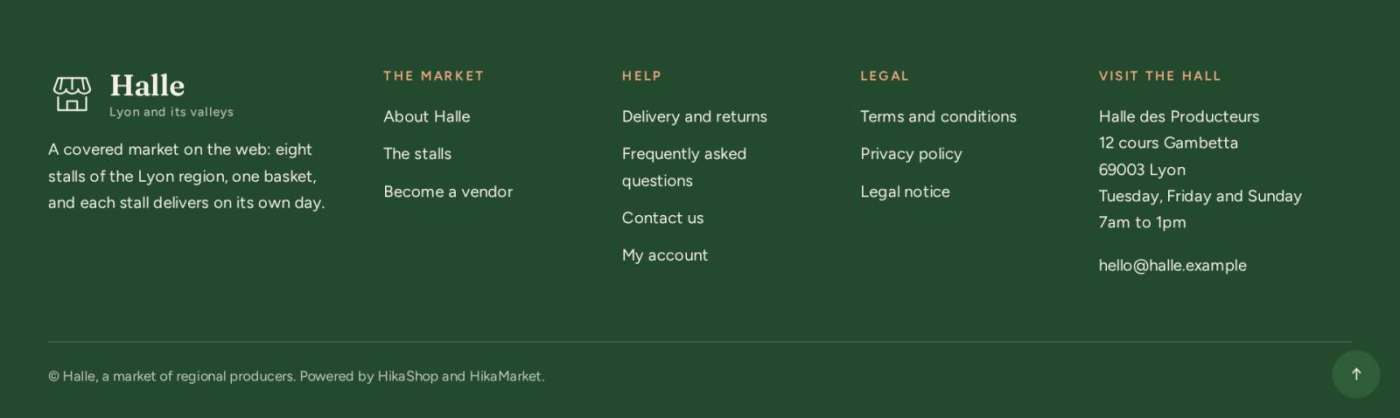
footer-a,footer-bandfooter-c(title shown: "The market", "Help", "Legal"), and two Custom modules,footer-brandandfooter-d, with the code below.
footer-brand (title hidden):
<p>A covered market on the web: eight stalls of the Lyon region, one basket, and each stall delivers on its own day.</p>
footer-d (title shown: "Visit the hall"):
<address>Halle des Producteurs<br>12 cours Gambetta<br>69003 Lyon</address> <p>Tuesday, Friday and Sunday<br>7am to 1pm</p> <p><a href="mailto:This email address is being protected from spambots. You need JavaScript enabled to view it. ">This email address is being protected from spambots. You need JavaScript enabled to view it. </a></p>
Also put the Breadcrumbs module in the position breadcrumbs.
8. Build the home page
The home page is the Home menu item's page: the hero (Home page tab of the template), then the modules of the positions home-categories, home-promises, home-stalls, home-picks, home-map and newsletter, each as a band of the page. A position without a module is left out. Create each module in Content > Site Modules > New; the settings below are those of the demo.
The hero
Set in the Home page tab of the template (step 4): the picture, the small line, the title, the text and the two buttons. The main button goes to your products, the second one to the directory of the stalls.
The departments (position home-categories)
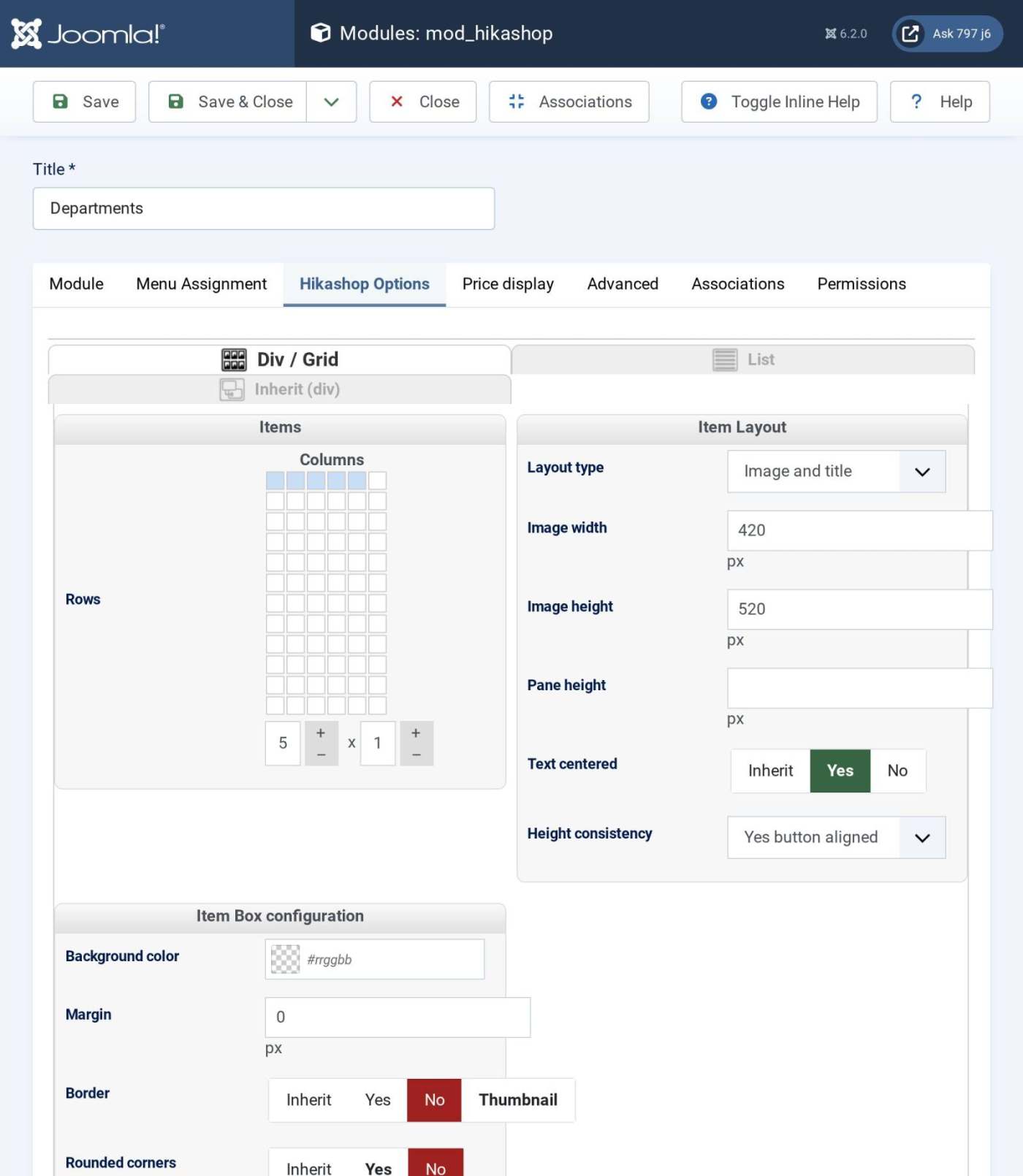
A HikaShop Content module (type Hikashop Module), title hidden. In its Hikashop Options tab: the layout Div / Grid, a grid of 5 columns x 1 row, Layout type = Image and title, Image width 420 and Image height 520 (a tall picture: Halle draws it as an arch), Text centered = Yes; further down, the content: Type of content = Category, the sub-categories of Product category (your departments), and Link on main categories = Yes, with a menu item of your products listing for the links. Give each category a picture in HikaShop > Categories.
The promises (position home-promises)
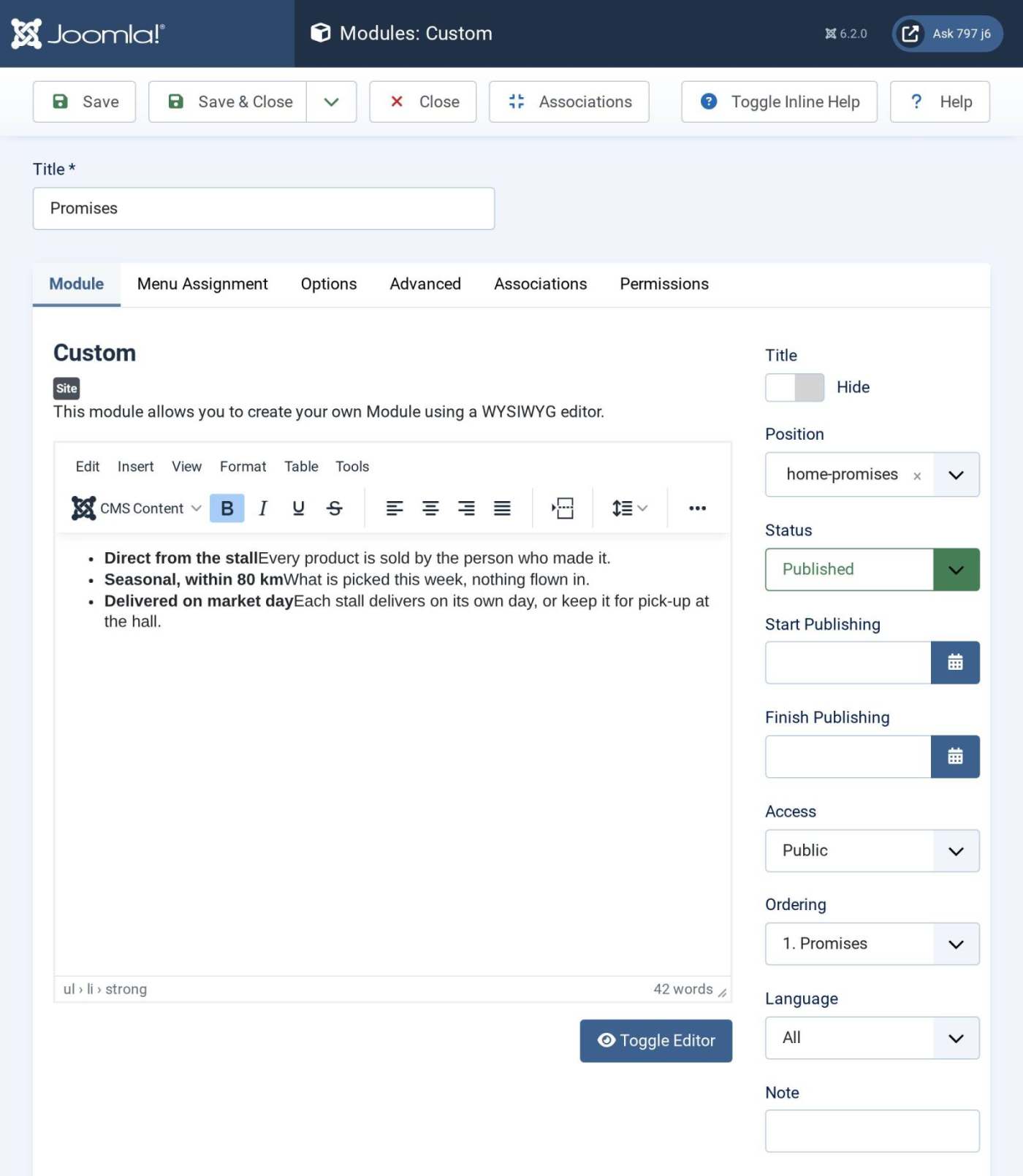
A Custom module, title hidden. In the editor, click Toggle Editor to write the HTML and paste this code (three promises: their title, then a line):
<ul class="hl-promises">
<li><strong>Direct from the stall</strong><span>Every product is sold by the person who made it.</span></li>
<li><strong>Seasonal, within 80 km</strong><span>What is picked this week, nothing flown in.</span></li>
<li><strong>Delivered on market day</strong><span>Each stall delivers on its own day, or keep it for pick-up at the hall.</span></li>
</ul>

The stalls (position home-stalls)
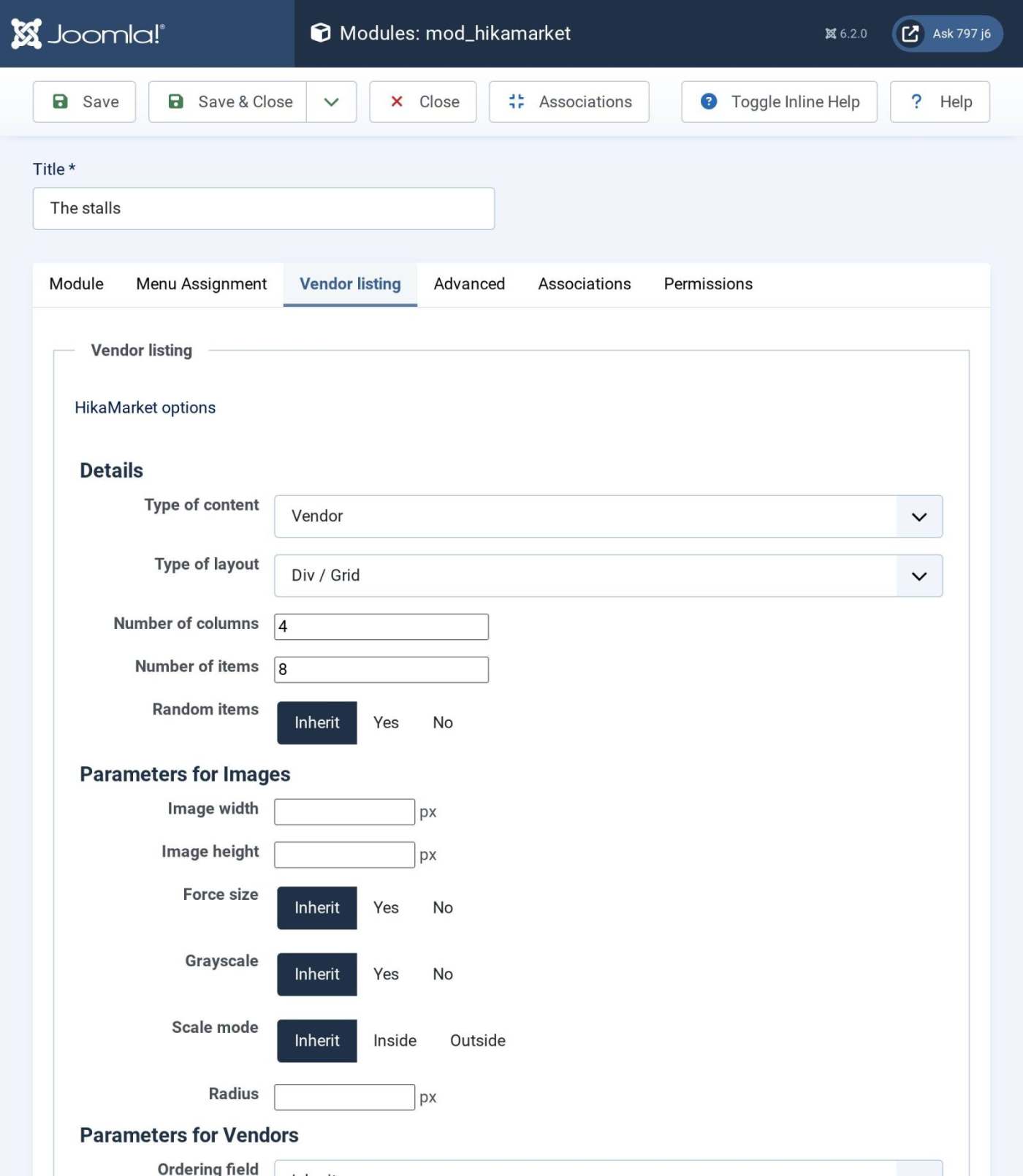
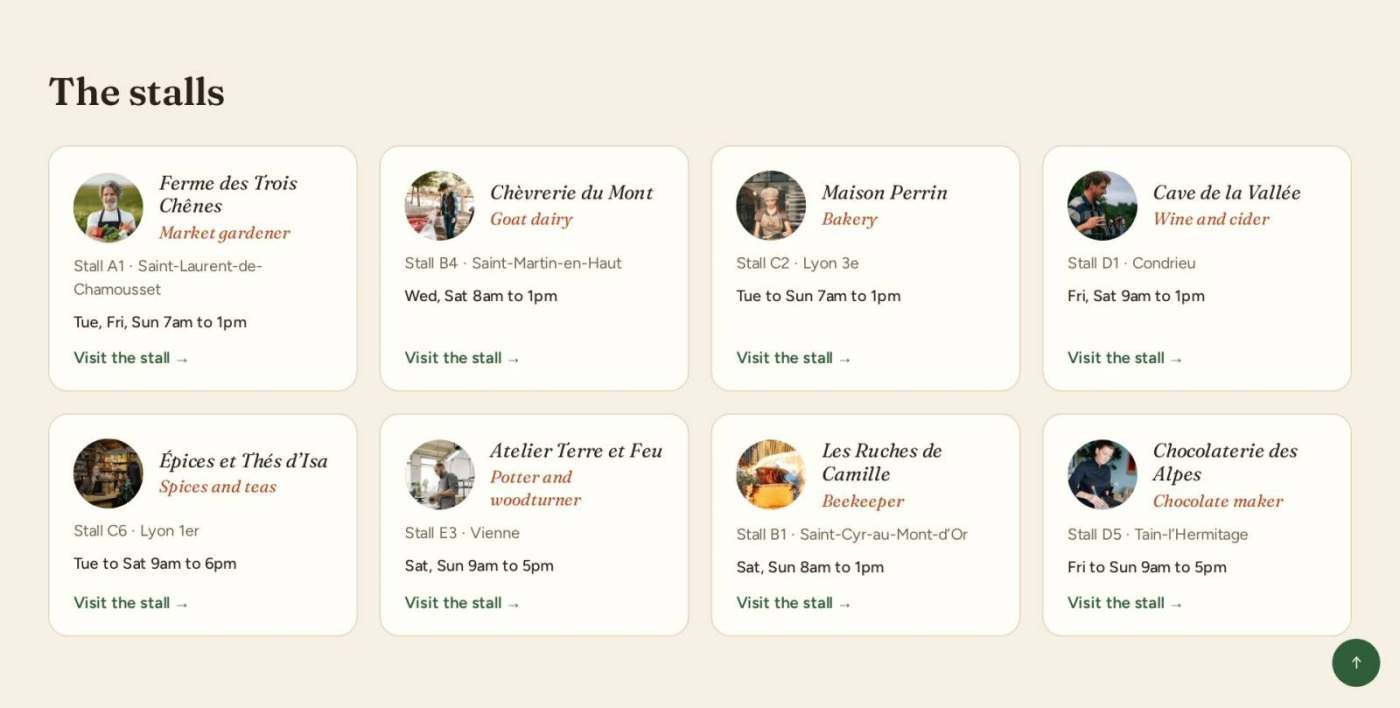
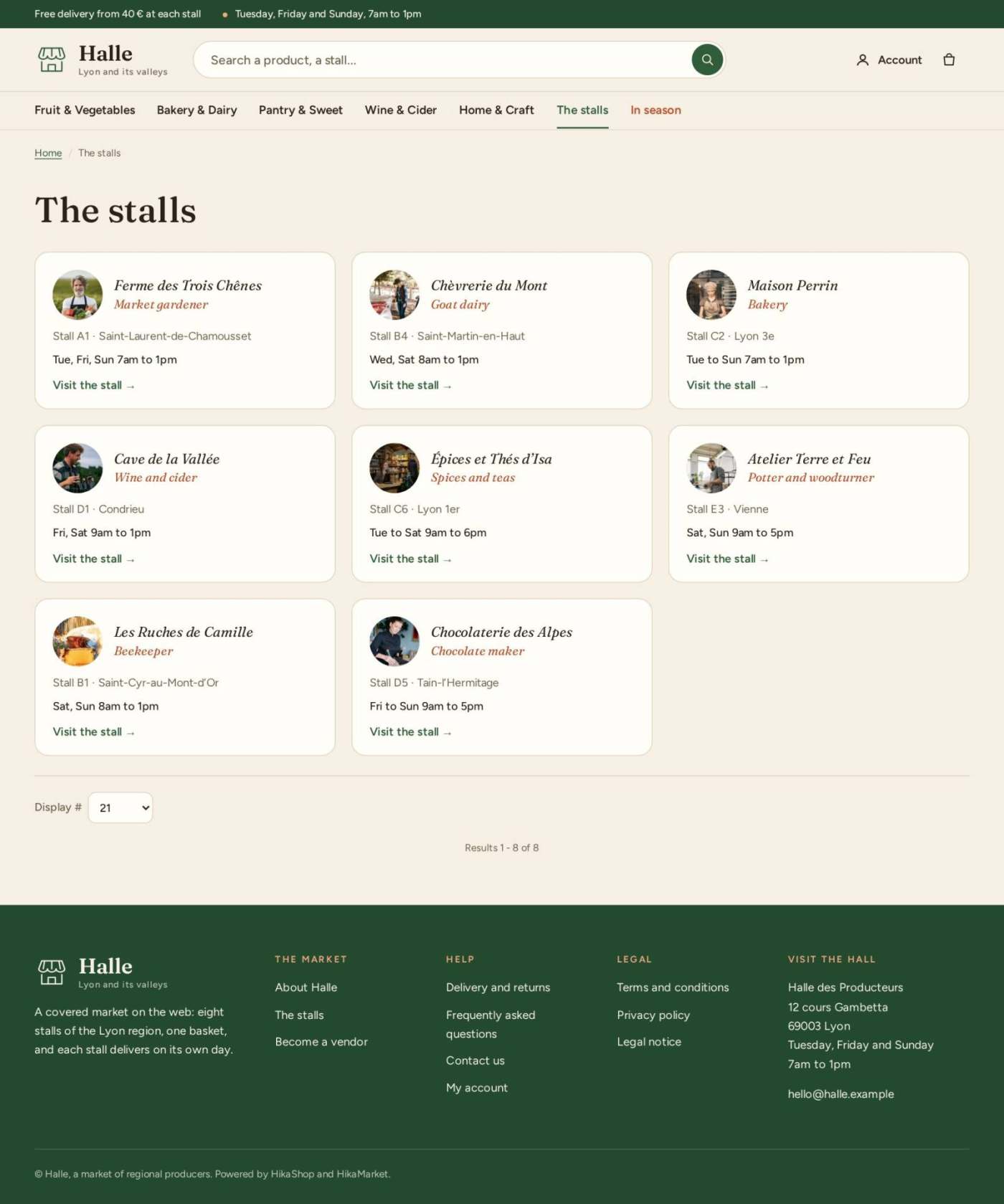
A HikaMarket module (type HikaMarket), title shown ("The stalls"). In its Vendor listing tab: Type of content = Vendor, Type of layout = Div / Grid, Number of columns = 4, Number of items = 8, Type of item layout = Image and title, Link to vendor page = Yes. Halle draws each vendor as a stall card with its portrait, its name, its trade, its stall number and place, its opening hours and a link to its front page.
The picks of the week (position home-picks)
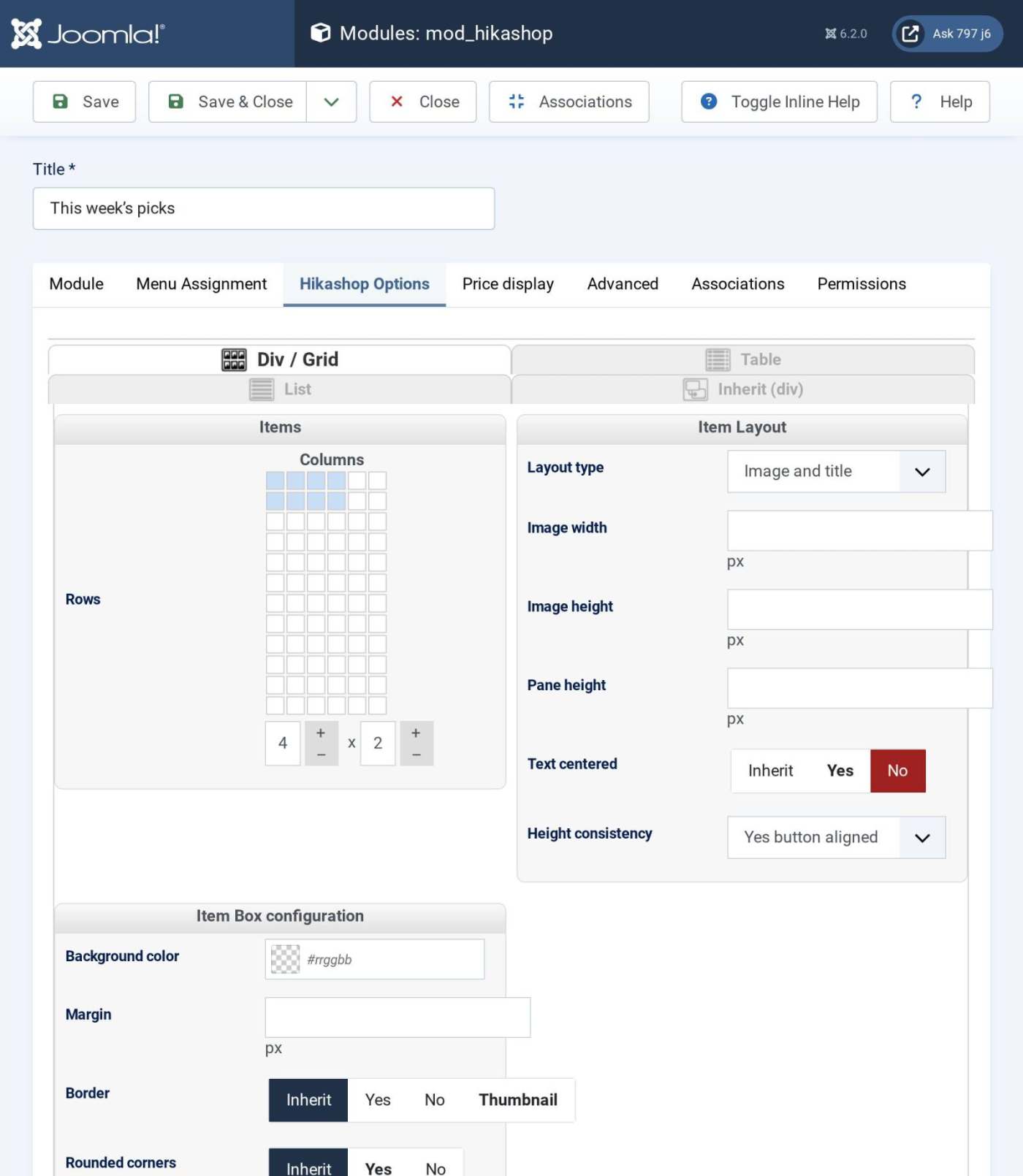
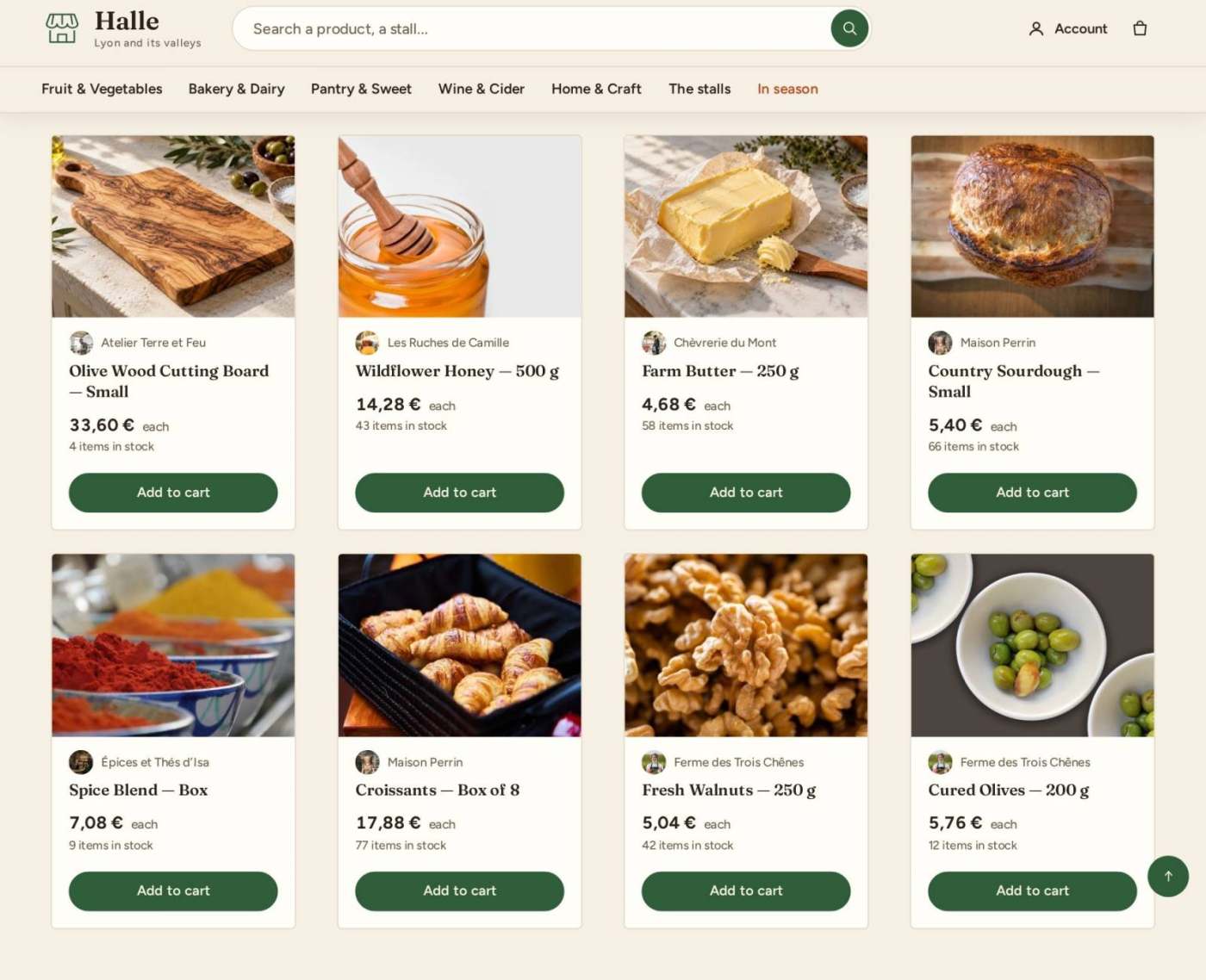
A HikaShop Content module, title shown ("This week's picks"), layout Div / Grid, 4 columns x 2 rows, Layout type = Image and title, and as content Type of content = Product, 8 items, the latest first (ordered by creation date, descending), from every sub-category of Product category (All sub elements). Each card carries the vendor line (the stall's portrait and name), the price (with the price per unit for a product sold by weight), the stock and the Add to cart button.
The map of the stalls (position home-map)
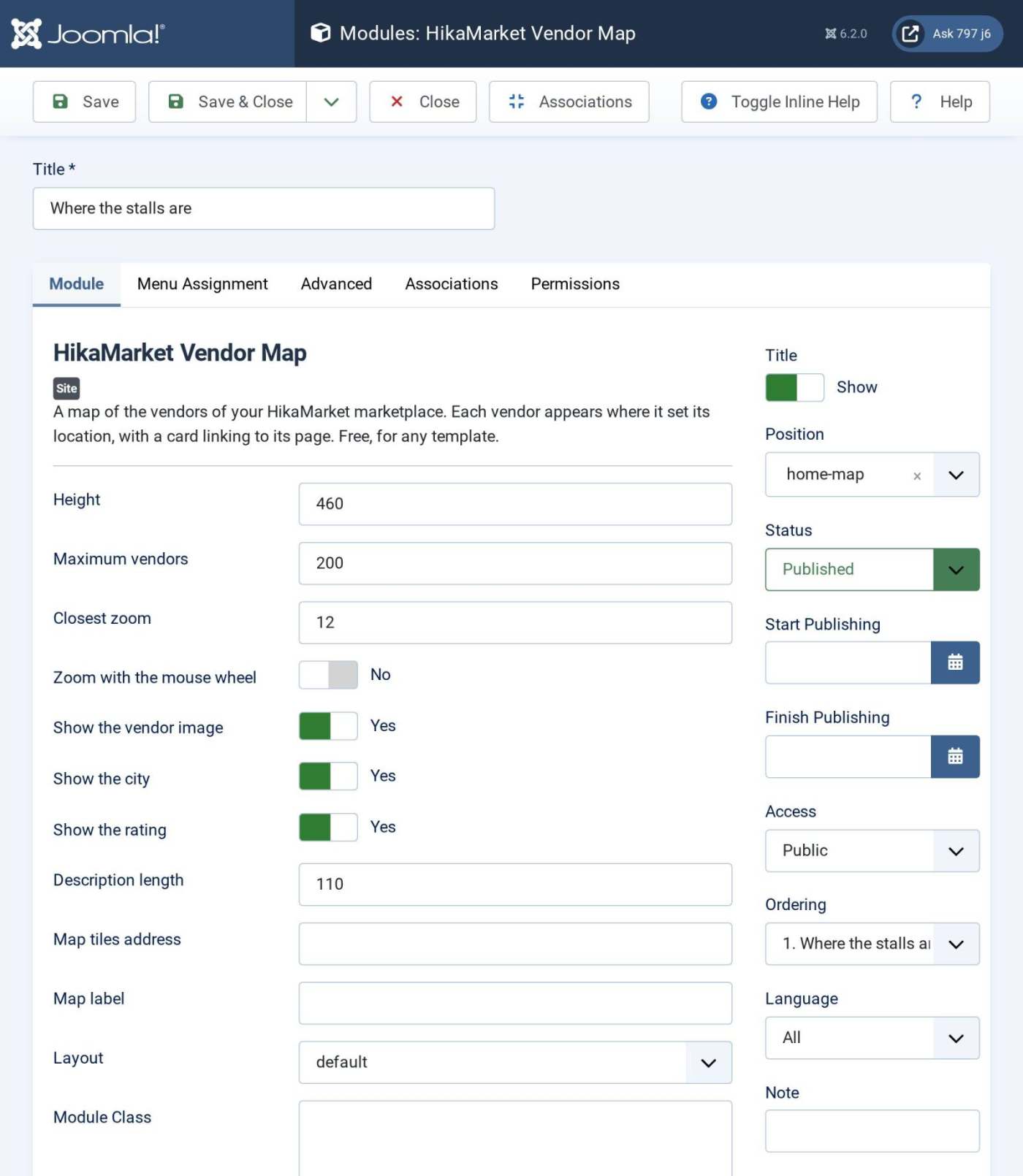
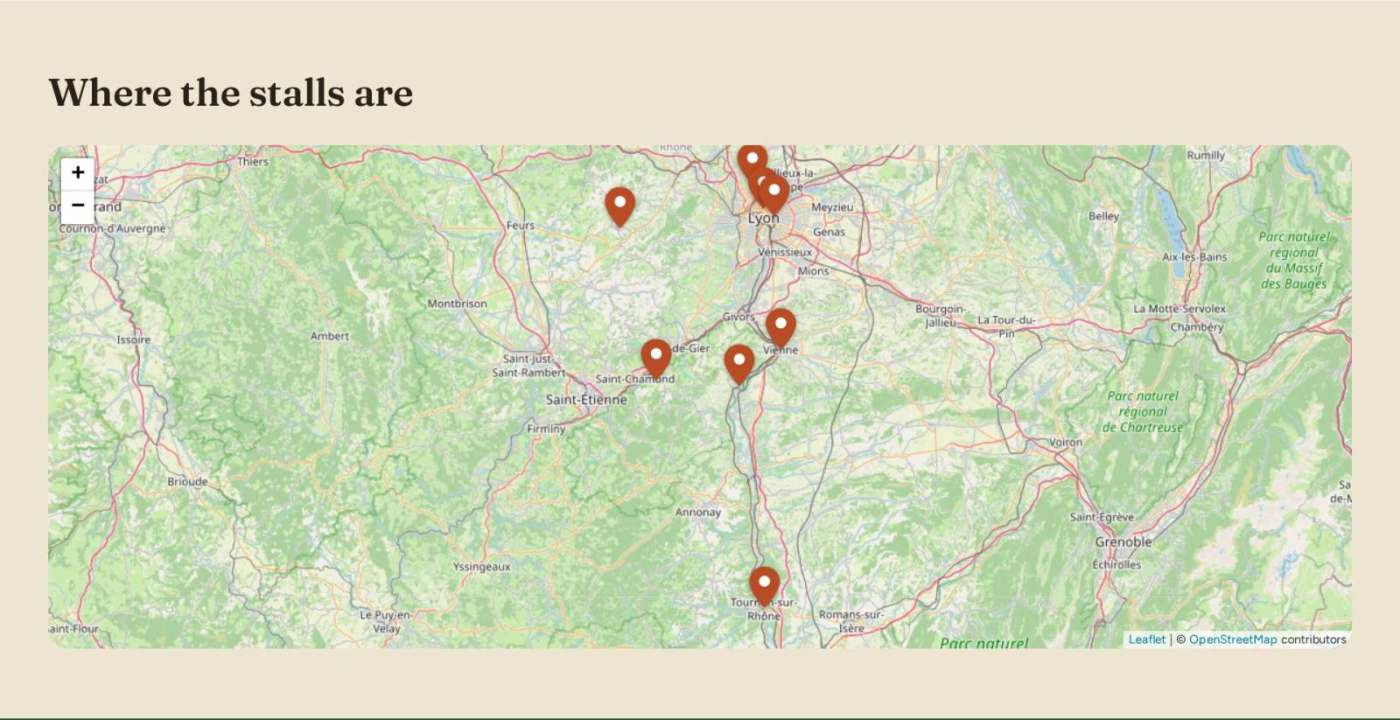
A HikaMarket Vendor Map module (type HikaMarket Vendor Map, free), title shown ("Where the stalls are"). It draws a map with one pin per stall, from the Vendor location of each vendor (latitude and longitude, see step 9), with the stall's picture, name, place and rating in the pin's bubble. Its settings are the Height (460), the Maximum vendors (200), the Closest zoom (12), Zoom with the mouse wheel (No, so that the page still scrolls over the map), what a pin's card shows (Show the vendor image, Show the city, Show the rating, Description length) and the address of the map tiles (empty: OpenStreetMap). The pins take the colour of the template.
The newsletter (position newsletter)
A band before the footer, on every page. Put the module of your newsletter service there (a Custom module with its form, or the module of the extension you use). The demo leaves it empty.
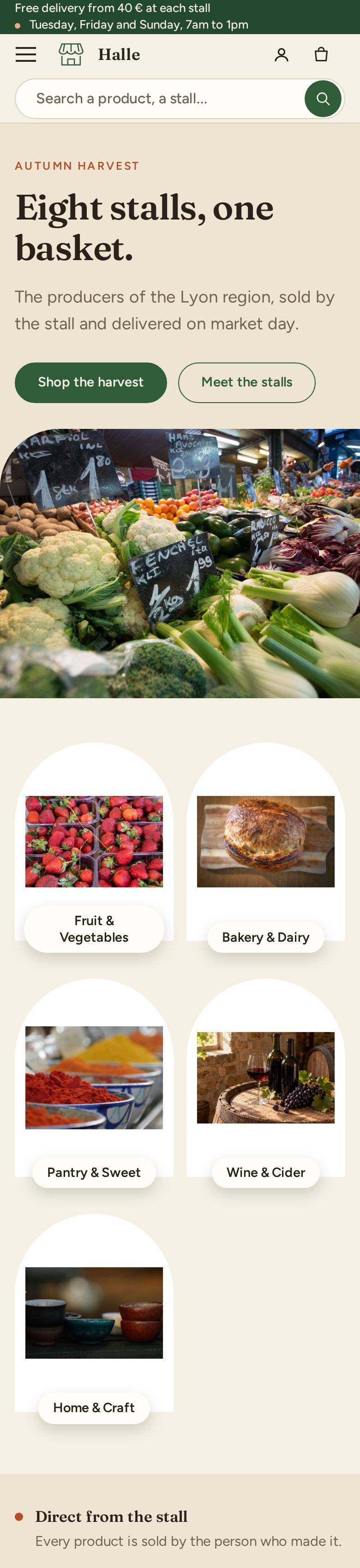
Here is the home page on a phone:
9. Set up the marketplace with HikaMarket
HikaMarket turns the shop into a market: each product belongs to a vendor, the cart and the checkout are split by vendor, each vendor has a front page, and each vendor ships its own goods. The tutorial HikaMarket Multivendor Tutorial explains every mode of a marketplace. These are the settings of a market of independent stalls that deliver on their own, as in Halle.
The market options
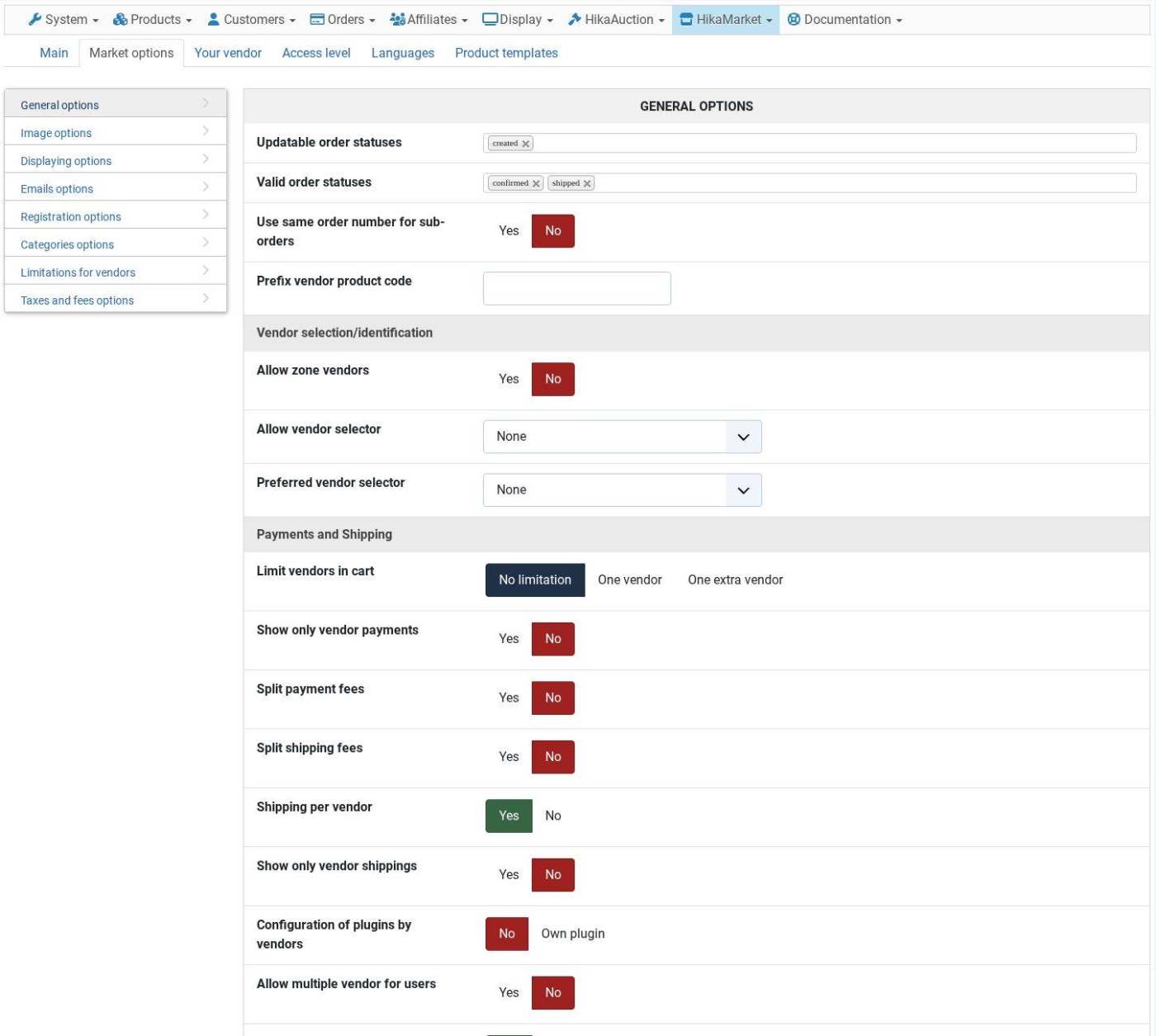
Open Components > HikaMarket > Configuration, tab Market options. The sections are listed on the left. The ones a market of stalls needs:
- Payments and Shipping (in General options): Shipping per vendor = Yes (the default): each stall offers its own shipping methods and its own price, and the customer chooses one per stall. Limit vendors in cart = No limitation to let one basket hold goods of several stalls. Show only vendor payments = No while the market takes the payment for the stalls.
- Registration options: Allow vendor registration (Manual validation lets you visit a farm or a workshop before a stall opens), and what the registration form asks for (a password, the description, the terms, the PayPal email, the currency).
- Categories options: Create categories for vendors (a category of its own per stall) and Change vendor root category (the category where the products of a stall are put).
- Taxes and fees options: the commission of the market (see "Fees and payments" below).
- Displaying options: Modules under the vendor page: the module shown at the bottom of a stall's front, see "Products, categories and the front of a stall".
The fields of a stall
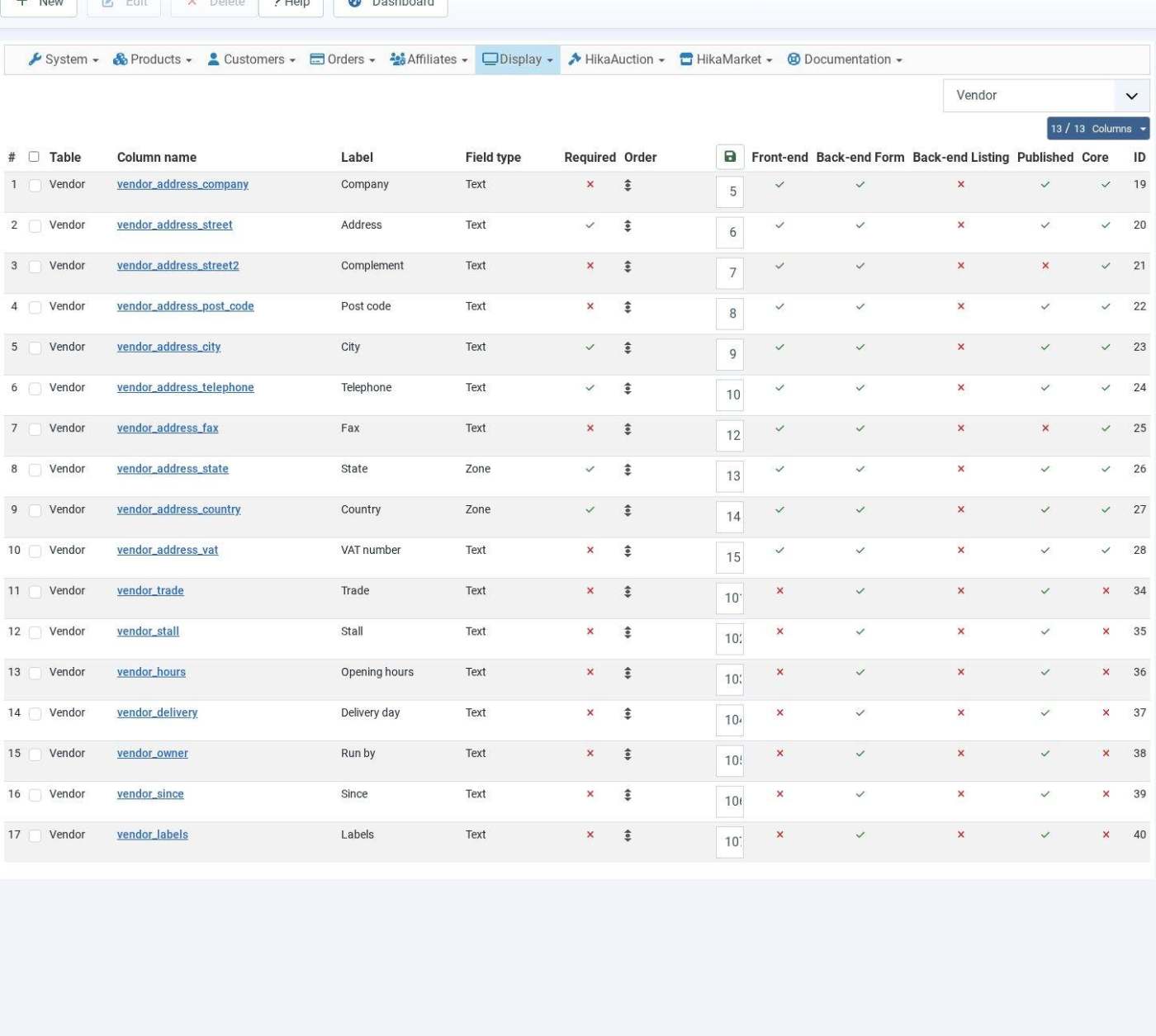
The stall cards, the vendor line, the stall's front page and the product page use four vendor fields: the trade, the stall number, the opening hours and the delivery day. Create them in HikaShop > Display > Custom fields with New: Table = Vendor, Field type = Text, and these column names (the names written in the Market tab of the template): vendor_trade (label "Trade", for example "Goat dairy"), vendor_stall ("Stall", for example "B4"), vendor_hours ("Opening hours", for example "Wed, Sat 8am to 1pm") and vendor_delivery ("Delivery day", for example "Saturday"). The demo has three more, shown on a stall's front: vendor_owner ("Run by"), vendor_since ("Since") and vendor_labels ("Labels"). A vendor field is on the vendor registration form as soon as its Display in options say so; see HikaMarket Vendor edition.
The vendors and their stalls
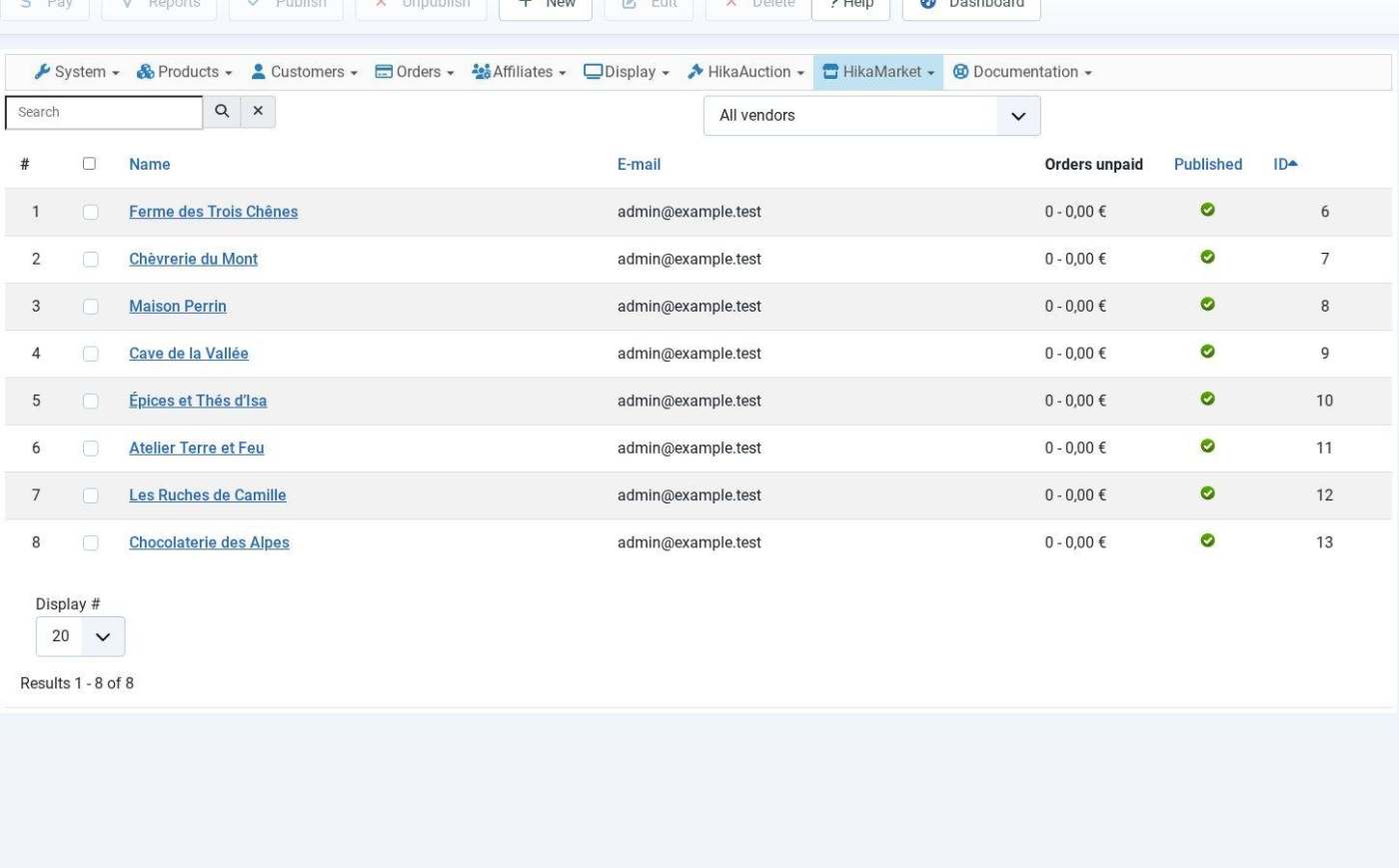
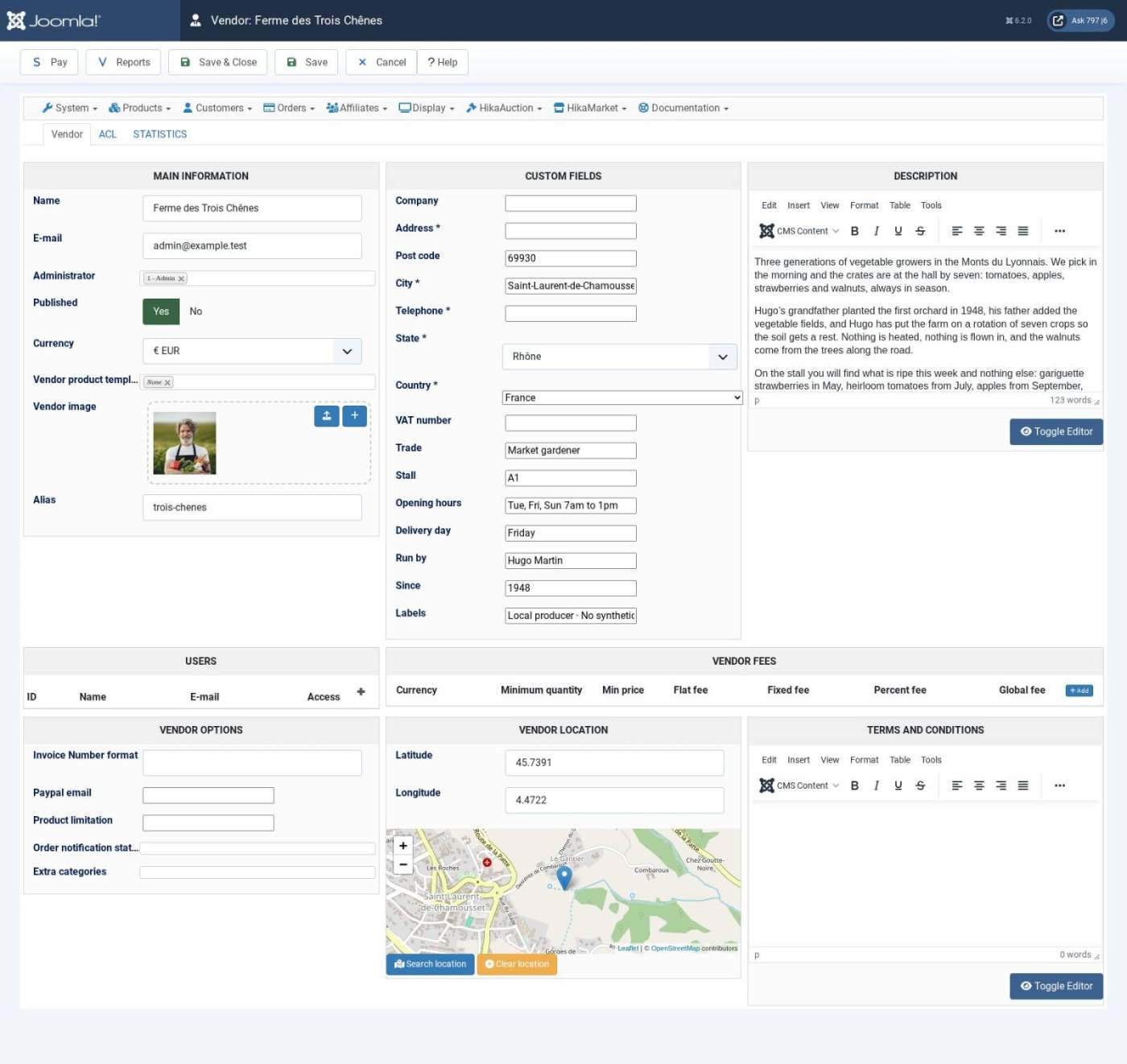
Open Components > HikaMarket > Vendors and click New, or let the vendors register (next part) and validate them here. A vendor's form holds:
- Name, Alias (the end of the address of its front page) and Administrator (the Joomla user who manages the stall).
- Vendor image: the portrait shown on the stall card, on the product cards and in the cart. A square picture of the person or of the stall fits best.
- The custom fields: address, post code, city and the four fields of Halle (trade, stall, opening hours, delivery day), and the extra ones.
- Description: the story of the stall, shown on its front page. The first paragraph is shown larger.
- Vendor location: a latitude and a longitude, or click Search location and move the pin. The map of the home page and the small map on the stall's front use it.
- Vendor fees: the commission of the market for this vendor (see below).
The directory of the stalls is the page of the Vendor listing menu item:
Vendor registration and the vendor area
A producer who wants a stall registers on the page of your "Become a vendor" menu item (a Vendor edition item): their account, their address and the fields of the stall (trade, stall, opening hours...), their description and the terms. With Allow vendor registration on manual validation, the new vendor waits for your approval in Components > HikaMarket > Vendors. Once the stall is open, its vendor reaches the vendor area (the Vendor Control Panel menu item): its statistics, its products, its orders and its customers, its categories and its discounts, in the look of the template. What a vendor may do there is set by the access levels, see the Access level tab of the configuration.
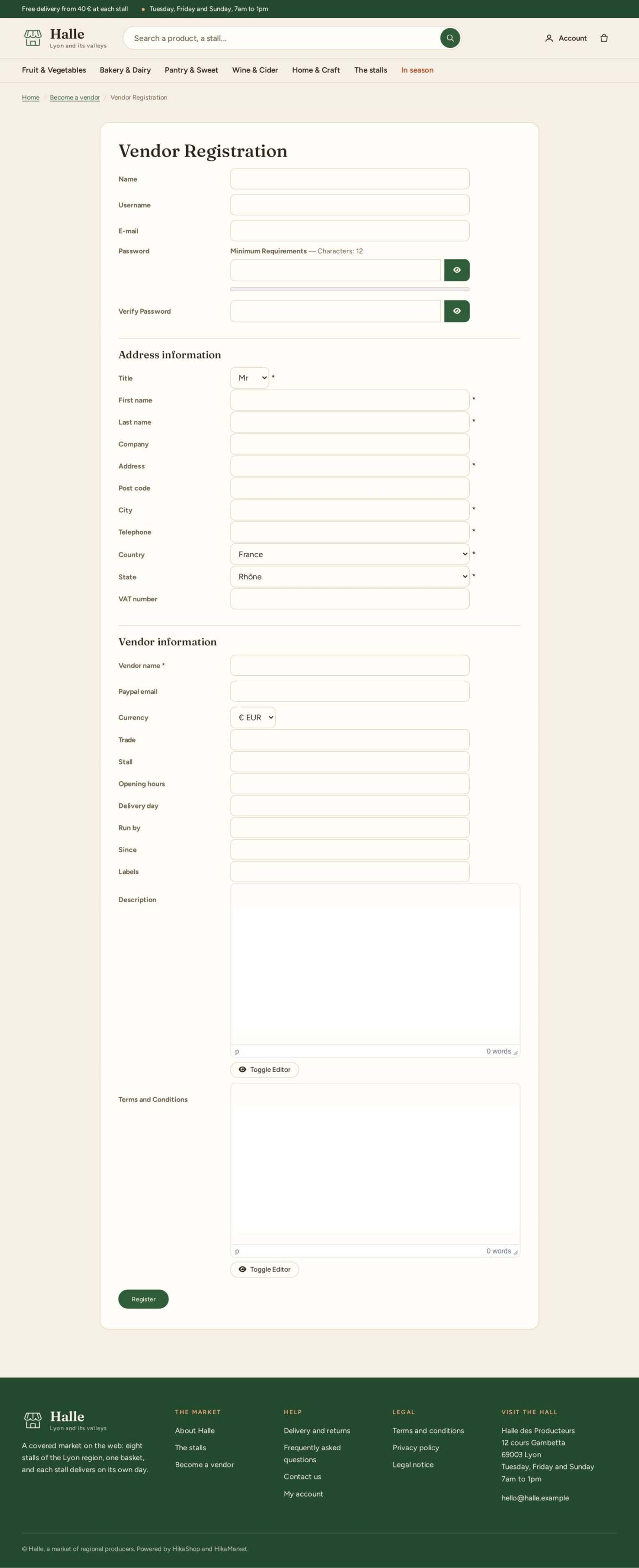
Products, categories and the front of a stall
- A vendor creates its products in its vendor area (Products > New); you can also edit a product in HikaShop > Products and choose its Vendor in the Main information box. Each product shows "Sold by" with its stall's portrait, in the listings, on its page, and in the cart.
- The products of the stalls are in the department categories of your shop (a product can be in several), so the listings of the main menu show the goods of every stall. Use Change vendor root category to decide where the products created by a vendor are put.
- The front of a stall (a Vendor page or the card's link) shows the stall's portrait, its trade, its words, its facts (opening hours, delivery day, run by, since, labels), a map, then its products. The products are a HikaShop module: create a HikaShop Content module in the position
halle-stall(4 columns, 3 rows, 12 items, Type of content = Product, Filter same vendor = Yes in its Hikashop Options; assigned to no page), then choose it in Components > HikaMarket > Configuration > Market options > Displaying options > Modules under the vendor page. The demo has this module, named "Products of the stall".
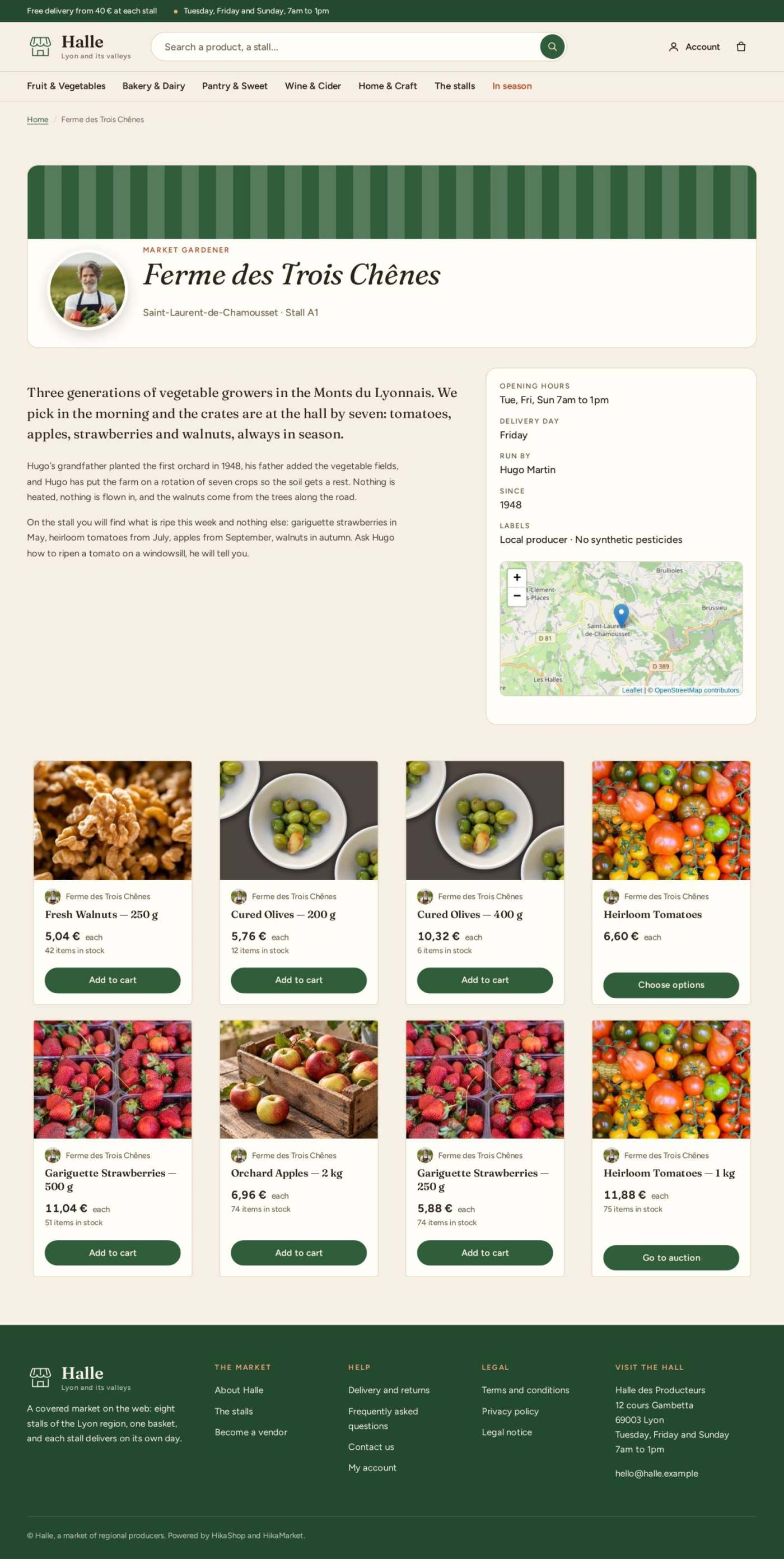
Fees and payments
The market lives on a commission. Taxes and fees options of the Market options (and Vendor fees of each vendor, and of each product) hold the rules: a percentage, a fixed fee, a minimum price. Read HikaMarket fees before you set them. Who is paid, and when, depends on the market mode: the market takes the payment and pays its vendors later (the mode of Halle's demo), or the vendors are paid directly (HikaMarket has payment plugins for that); see the Multivendor tutorial.
Delivery, and free delivery per stall
With Shipping per vendor, the checkout asks one shipping method per stall: each stall has its block, with the methods it offers and their price, and a delivery note (the delivery day of the stall). The shipping methods are those of HikaShop > System > Shipping methods; each is a normal HikaShop method, whose restrictions are checked against the goods of one stall at a time. See Shipping method Add/Edit.
Free delivery is a shipping method at 0 € with a minimum price, per stall. It is not a setting of the template, and the template has no free delivery bar. To offer it:
- Create a manual shipping method called "Free delivery": Price 0, Minimum price 40 (the threshold, per stall), With tax = Yes when your prices are shown with tax (the threshold is then compared with the subtotal of the stall with its taxes).
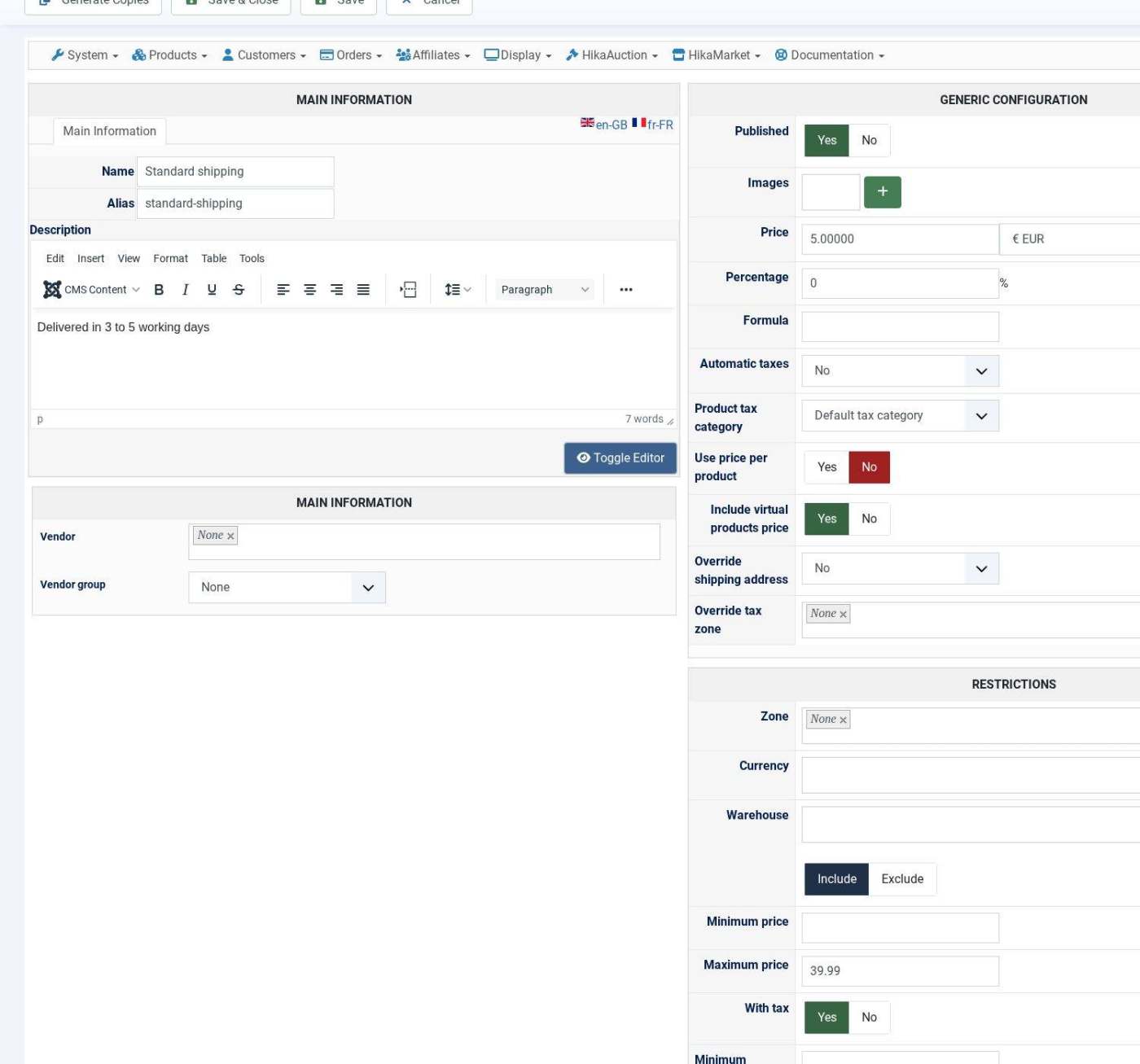
- Give your paying method (here "Standard shipping", 5 € before tax) a Maximum price of 39.99, so that a stall whose goods reach 40 € no longer offers it and a stall under 40 € does. Express shipping and pick-up have no limit.
- Write the threshold in the Strip above the header setting of the template (step 4) and in your delivery page, so that they say the same as the shipping methods.
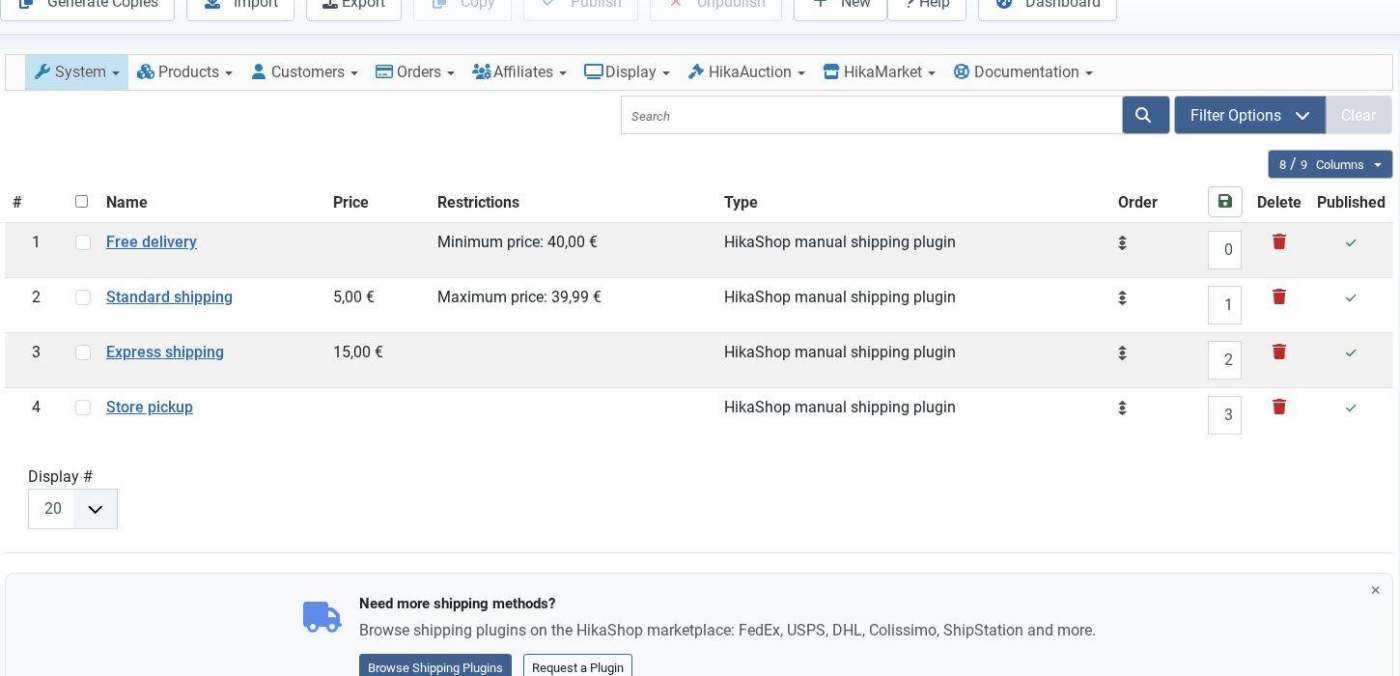
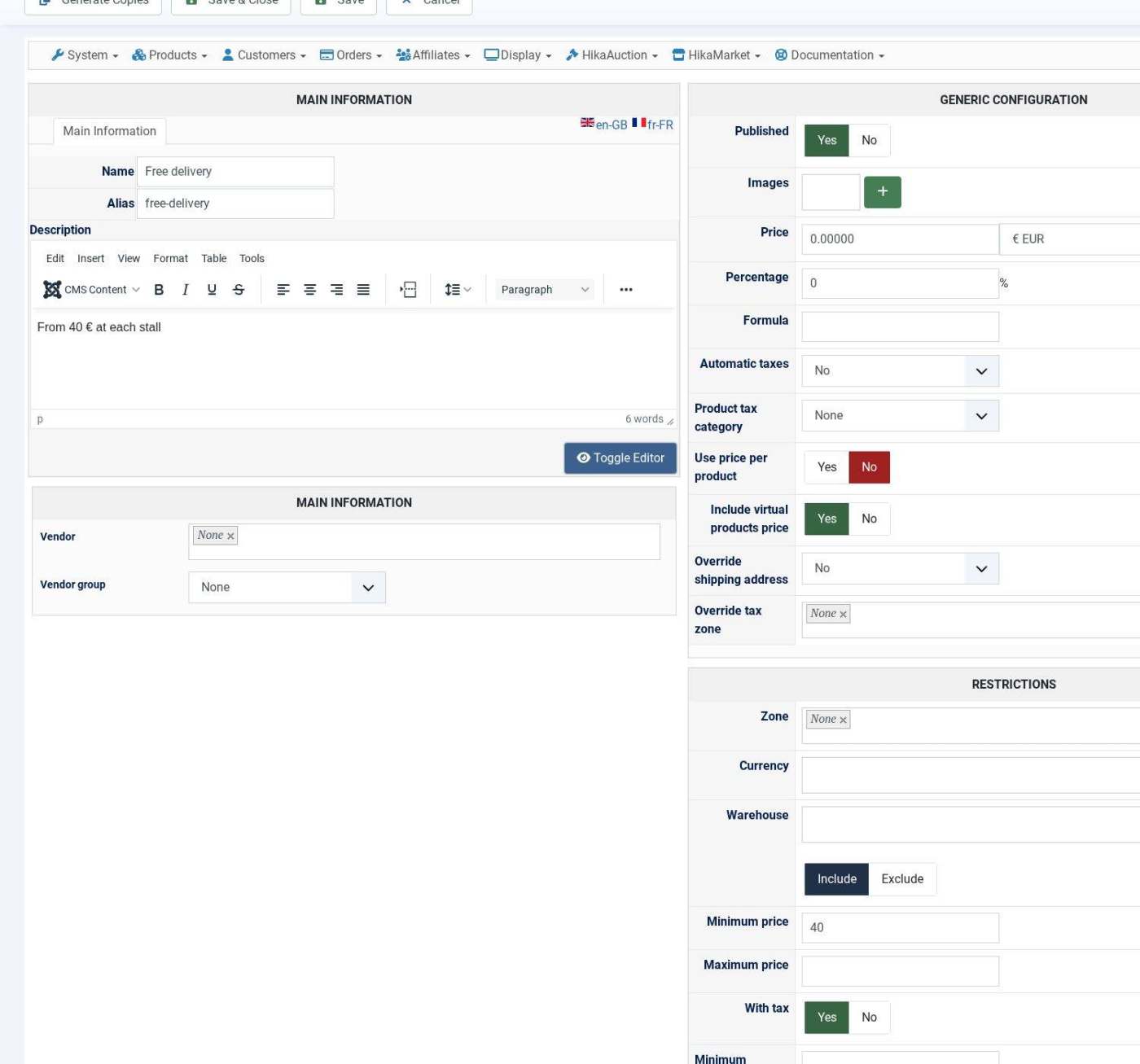
In a basket with goods from two stalls, the stall that reaches 40 € offers Free delivery, Express shipping and Store pickup, and the one under 40 € offers Standard shipping, Express shipping and Store pickup. The shipping total adds the choice of each stall.
10. HikaShop settings for the look of the shop
Open HikaShop > System > Configuration, tab Main:
- Thumbnail (width x height) and Product page image (width x height): the demo uses 560 x 420 for the cards and 720 x 720 for the product page. Halle draws the pictures larger than that on a wide screen, so do not go smaller.
- Force images size = Yes and Image scale mode = Crop (outside): every card has the same shape.
- Show taxed prices: the demo shows its prices with tax from the listing to the checkout, as a consumer market does. For a taxed price to be right, give each product a tax category and have a tax rule for the customer's country.
- Vendors: HikaMarket shows the vendor on the product and in the cart from its HikaShop plugin; check that HikaShop > System > Plugins lists it as enabled.
11. Before you sell
- Place a test order with each payment method, and watch the emails: the vendors get theirs.
- Check the shop on a phone: the menu folds behind a button, the product page has its add-to-cart bar, the cart drawer groups the goods by stall.
- Replace the sample pages (terms, privacy, legal notice) with your own.
- Check the taxes, the shipping methods and the free delivery threshold, and that the strip says the same.
12. Your own CSS
Add your own rules in the user.css file of the template (media/templates/site/halle/css/user.css): it is loaded last and an update of Halle never overwrites it. The same goes for media/templates/site/halle/js/user.js.
Questions
The home page shows no section. The sections show on the page of the menu item flagged Home; check that it is the default item and that its type is Featured Articles, and that your modules are assigned to it (Menu Assignment).
A stall card has no portrait. Add the Vendor image in its form. The names, trade and places come from the vendor fields: check their column names against the Market tab of the template.
The map is empty. The pins come from the Latitude and Longitude of the vendors (Vendor location); a vendor without them has no pin.
A stall offers no shipping method. Each stall is checked against the restrictions of the method (zone, minimum and maximum price, weight). With Shipping per vendor, the maximum price of Standard shipping hides it from a stall whose goods reach it: another method must be available at that price (the free delivery).
The fonts are not the ones of the preset. The fonts are served from images/halle-fonts once downloaded; clear the Joomla cache and your browser's.