
|
|

Description
This screen ("HikaAuction->Configuration") enables you to configure HikaAuction.
During the install process, HikaAuction will be automatically configured using your Joomla Configuration but you can modify it at any time.
You will also find a tool to easily add/modify the HikaAuction languages files.
Toolbar

- Save : Save the configuration and return to the dashboard screen.
- Apply : Apply the modifications to the configuration and stay on the same screen.
- Cancel : Return to the previous screen without saving the modifications.
- Help : This button enables you to turn ON/OFF the help section, this screen will appear or disappear.
Behaviour options
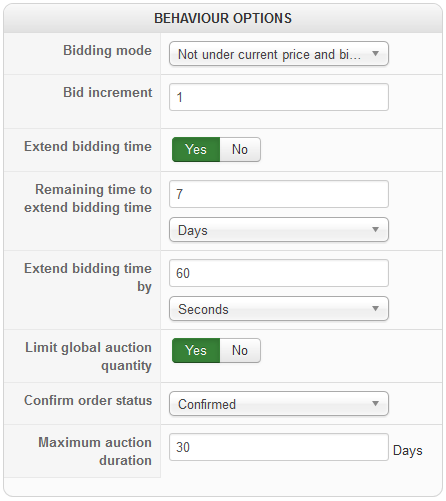
- Auction mode : This setting determines the type of auction used across your store :
- Vickrey auctions (default) : Bidders place maximum bids. The winner pays the second-highest bid plus the bid increment.
- English auctions : Traditional ascending auction. The winner pays their own bid amount (the highest bid).
- Dutch auctions : The price starts at the product price and drops by a fixed amount at regular intervals. The first person to click "Buy" wins immediately at the current price. When Dutch mode is selected, the bidding mode, bid increment, and time extension settings are hidden.
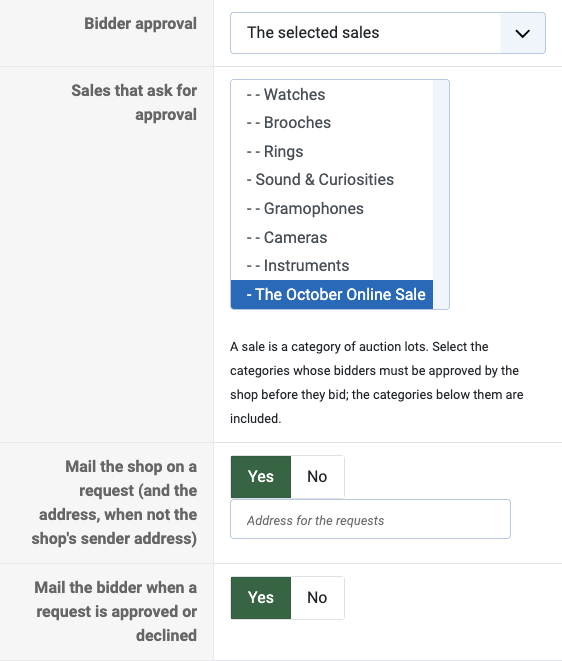
- Bidder approval : Whether your customers must be approved by the shop before they bid. With No (default), every logged in customer can bid. With Every auction, a customer needs an approval for any auction. With The selected sales, only the auctions of the categories selected below need one. The whole process is described in the "Bidder approval" page of this documentation.
- Sales that ask for approval : The categories whose bidders must be approved, when Bidder approval is set to The selected sales. A sale is a category of auction lots: an approval for a category also covers the categories below it. Hold Ctrl (Cmd on a Mac) to select several.
- Mail the shop on a request : Sends an email when a customer asks to be approved, with a button to the list of requests. It goes to the address typed next to it, or to the shop's sender address when it is empty.
- Mail the bidder when a request is approved or declined : Sends the customer an email with your decision and the note you wrote with it.
- Bidding mode : You can select here the bidding mode which will be used by your auctions :
- Not under current price and bid increment : Your customers will have to bid higher than your current price + the bid increment.
- Not under current price : Your customers will have to bid higher than your current price.
- Free bidding : Your customers will be able to bid what they want above the auction starting price.
- Bid increment : That option will enable you to set a bid increment which will be used when the "bidding mode" option is set to Not under current price and bid increment
- Allow fixed bids next to max bids (Vickrey only) : When enabled, the bid popup of your auctions offers two buttons. "Bid this amount" places a fixed bid: the current price becomes that amount right away, unless another bidder has a higher maximum bid, in which case that bidder's maximum answers automatically. "Set as max bid" places a maximum bid as usual: the price only rises when others bid, up to that maximum, which stays secret. Useful when your customers are not used to proxy bidding. The amount of a fixed bid stays visible in the auction history even when bid amounts are hidden, since it is the price itself. Disabled by default.
- Price drop amount (Dutch only) : The amount by which the price drops at each interval. For example, if set to 5 and the starting price is 100, the price will be 95 after one interval, 90 after two, etc. The price will never drop below the reserve price configured on the product.
- Price drop interval (Dutch only) : How often the price drops. You can set a number and choose the unit (hours, minutes, or seconds). For example, "5 minutes" means the price drops every 5 minutes.
- Extend bidding time : That option will enable you extend the bidding time of your Auctions.
- Remaining time to extend bidding time : Choose a delay to add to the auction remaining time if someone bid under a certain period before the end of the bidding.
- Extend bidding time by : That option will enable you to extend the bidding time by a defined amount of time.
- Limit global auction quantity : That option will enable your shop to dynamically check if an auction can be won regarding the value that you have set through the "Quantity per order" option of your product configuration page.
- Confirm order status : You can set here the order status which will be assigned to an order when a payment notification is received.
- Maximum auction duration : That option can be used to set the maximum number of day that the auction can be available.
- Buyer premium : A percentage fee that will be added on top of the winning bid amount. For example, if set to 10 and the winning bid is 100, the buyer will pay 110. Set to 0 to disable.
- Urgent auction : When enabled, auctions nearing their end will be visually highlighted to create urgency. You can configure the remaining time threshold below.
- Remaining time to be urgent : The time threshold under which an auction will be marked as urgent. You can choose the unit (days, hours, minutes, or seconds). For example, "30 minutes" means the auction will appear as urgent when less than 30 minutes remain. This setting is only visible when "Urgent auction" is enabled.
General display options
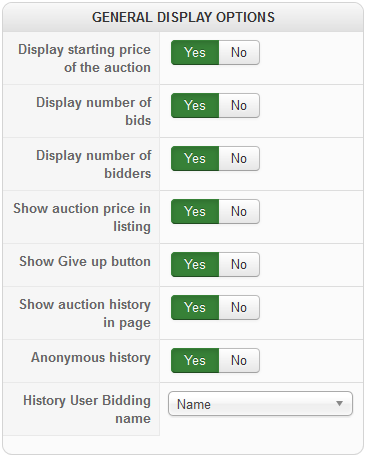
- Display starting price of the auction : You can turn on that option in order to display the starting price of Auctions on their product page
- Display number of bids : You can turn on that option in order to display the number of bids of an auction on its product page.
- Display number of bidders : You can turn on that option in order to display the number of bidders of an auction on its product page.
- Display bidding price : When enabled, the current bidding price (the minimum amount for the next bid) will be displayed on the auction product page. Enabled by default.
- Display winning price : When enabled, the current winning price will be displayed on the auction product page. Enabled by default.
- Display reserve price : When enabled, information about the reserve price will be displayed on the auction product page so that bidders know whether the reserve has been met. Disabled by default.
- Show auction price in listing : That option will enable you to dynamically display the current auction price instead of the starting price for auctions that are displayed through listings.
- Show auction status in listing : When enabled, an auction status badge (Upcoming, Live, Sold, Unsold, Cancelled) will be displayed on each auction product in listings. You can choose the badge position :
- No : No badge displayed.
- Top : The badge appears above the product image.
- After product name : The badge appears after the product name.
- Bottom : The badge appears at the bottom of the product card.
- Show Give up button : That option will enable you to display a give up button through the auction payment page.
- Show auction history in page : That option will add an Auction history table on your product page so that your customers can directly check it.
- Anonymous history : That option will enable you to display an Anonymous Auction history table on your product page so that your customers name won't be known by every bidders.
- Hide bid amounts in history : When enabled, bid amounts will be hidden in the auction history table. Bidders will see that bids were placed but not the amounts. This can be useful to keep bidding strategies private.
- History user bidding name : You can select here which customer name you want to display through your Auction history table :
- Username : It will display your customer username.
- Name: It will display your customer name.
- Bid button CSS class : You can set a custom CSS class for the bid button. The default value is "hikaauction_bid_button".
- My Bids button : When enabled, a "My Bids" button will be displayed in the user control panel, allowing users to see their bidding history across all auctions.
- Won Auctions button : When enabled, a "Won Auctions" button will be displayed in the user control panel, allowing auction winners to see all their won auctions and their payment status.
- Live bid updates : When enabled, the auction page will automatically refresh bid information (current price, number of bids, bid history) without requiring a full page reload. Enabled by default.
- Live bid updates interval : The interval in seconds between each automatic refresh of the bid information. The default value is 15 seconds. Lower values provide more real-time updates but increase server load. This setting is only visible when "Live bid updates" is enabled.
Advanced options
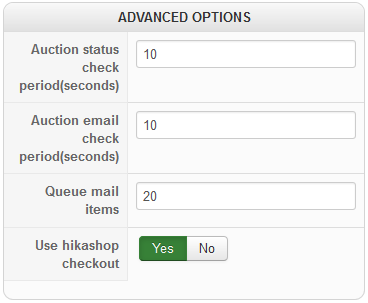
- Auction status check period (seconds) : That option will enable you to set the period that the auction system will have to wait before checking and updating every auction status.
- Auction email check period (seconds) : That option will enable you to set the period that the auction system will have to wait before checking and send every auction related emails.
- Queue mail items : By using that option, you will define the number of items related to your shop emails that will be sent each time the cron will be triggered.
- Cron URL : Cron URL to trigger HikaAuction's Cron. You should use this URL to create your cron task, please follow our tutorial on that.
You can make sure it's a working url by clicking on the link. - Use hikashop checkout : That option will enable your customers to directly pay the auction they won though the Hikashop Checkout (Not available with the checkout legacy mode).
- Sending an email.
- Updating an order.
Checkout Workflow
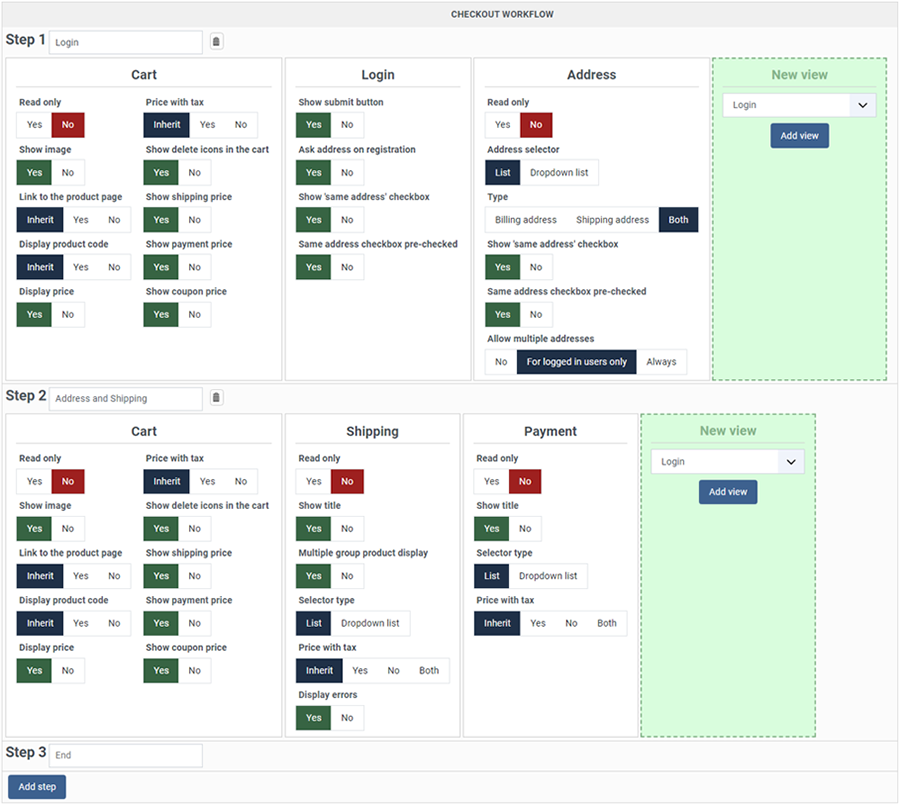
This section allows you to define a custom checkout workflow that will be used for auction carts. By default, HikaAuction comes with a ready-made checkout workflow (login, address, payment, confirm) tailored for auctions. You can customize it to fit your needs. Please make sure to configure a valid checkout workflow so that your customers can complete their auction purchases without issues. For more information on how to configure checkout workflows, please refer to the HikaShop checkout workflow documentation.
Languages
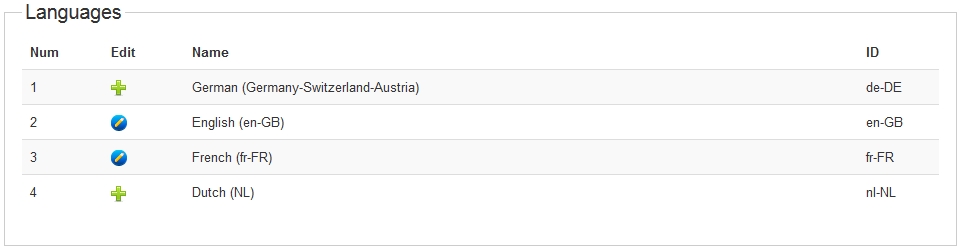
This listing displays the list of languages of your website (Front-End). For each language, you can edit the HikaAuction language file.
Languages files are not included in the package. You should click on the create button and the latest version of this language will be directly loaded from our website.
Then you simply have to save the language to have it on your website.
Please don't forget to share your translated language files so that we can include them in our next release.
Additionally two options will enable to activate the edition of content in multiple languages and define whether or not to publish the translations by default when using this edition mode. Note that it requires Joomfish to be already installed. If you use our free version, you can still translate your content via Joomfish as the content elements will be automatically added to Joomfish during install if JoomFish is detected.
If your multi lingual content is not displayed on the front end, please make sure that the JoomFish jfdatabase system plugin is enabled in the joomla plugins manager. Also, if you installed JoomFish after HikaShop or if the contentelements folder of JoomFish is not writable, you will have to copy the files manually from the folder administrator/components/com_hikashop/translations to administrator/components/com_joomfish/contentelements.