
PrestaShop is one of the most used shopping carts in Europe. HikaShop reads its database and moves the catalog, the customers and the orders of a PrestaShop shop to Joomla or WordPress. This page explains the steps and what to check.
It is one of the shops HikaShop can import: see all the import options.
Before you start
Supported versions: PrestaShop 1.7, 8 and 9 (tested on 9.2).
The PrestaShop database must be on the same MySQL server as the site which receives HikaShop.
Make a backup of your database and your files. The import adds to what is already in HikaShop and never deletes anything, but a backup costs nothing.
What is imported
- Taxes and tax rules groups, by country
- Brands (manufacturers)
- Categories, with their hierarchy
- Products, with their prices, tax, stock, dimensions and texts
- Combinations, as variants with their characteristics, price and stock
- Images
- Customers and their addresses, guests included
- Coupons (cart rules with a code)
- Orders, with their lines, addresses, shipping and discount amounts
- Downloadable products
Not imported:
- The specific prices, the packs, the customizations and the payment and shipping modules
Steps
- In the HikaShop back office, open Products > Import and choose Import from another shop.
- Pick PrestaShop in the list of shops.
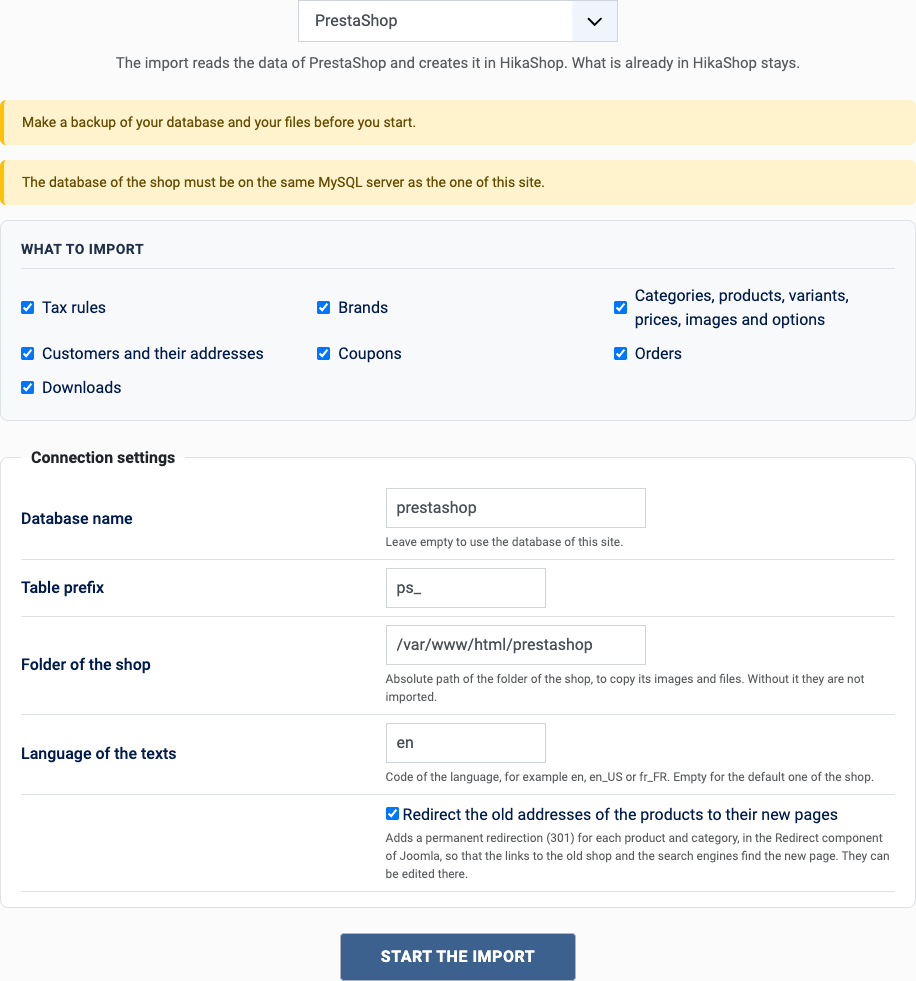
- Choose what to import with the boxes of "What to import": orders also need the customers and the catalog, they are imported with them.
- Fill in the settings (see below) and click Start the import.
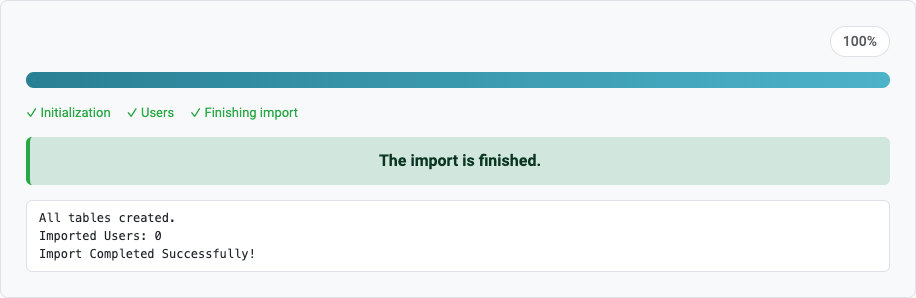
- Keep the page open until the message "The import is finished" appears. A step which fails stops the import and can be tried again or skipped.
The settings
- Database name: the database of PrestaShop (empty if it is the one of this site).
- Table prefix: ps_ by default, see the prefix in app/config/parameters.php.
- Folder of the shop: the absolute path of PrestaShop, to copy the images (img/p) and the downloadable files.
- Language of the texts: the code of the language to read, for example en or fr. Empty for the default language of the shop.
- Redirect the old addresses (Joomla only): tick it to send the visitors of the old addresses to the new pages, see the questions below.
After the import
- Tell your customers to use "Forgot your password" on the new shop.
- Set up your payment and shipping methods.
- Check a product with combinations: each combination is a variant of the product.
Questions
Do the customers keep their password?
Yes. The recent PrestaShop passwords (bcrypt) are moved as they are. The older ones are an md5 of the password with the cookie key of the shop: HikaShop reads that key in the folder of the shop (app/config/parameters.php, or config/settings.inc.php on PrestaShop 1.6), so fill in "Folder of the shop". The "Authentication - Imported shop passwords" plugin, which the import turns on, checks the password at the first login and stores it as a regular Joomla password. Without the folder, the customers with an older password ask for a new one with the password reset form.
The texts are in the wrong language
Set the language of the texts to the code of the language you want (en, fr...).
Where is the table prefix?
In the file app/config/parameters.php of PrestaShop, under database_prefix.
Can I run the import again?
Yes. What was already imported is left alone and only what is new is added: the products, customers and orders created on the old shop since the last import. You can import once to test and again when you go live. A change made on the old shop to something already imported is not copied.
The old addresses of the products
With "Redirect the old addresses" ticked (Joomla only), each product and category gets a redirection from its friendly address (with the category of the product or without it, with the language when the shop has several) and from its address with index.php?controller= to its new page. It only works when the new site answers on the same domain as the old shop. The redirections are in Components > Redirects of Joomla, where they can be edited or removed; the import turns on the plugin "System - Redirect" which uses them.
Back to the import page, which also covers the CSV import and the import of orders. Something else went wrong? See solving problems.